Sunday, October 30, 2022

"Understanding Air Quality Data in the Bay Area" - An Interview With Michael Flagg of the Bay Area Air Quality Management District

by Samantha Dvorin, Archie Williams High School 

Michael Flagg is a principal air quality specialist at the Bay Area Air Quality Management District (BAAQMD) in the Ambient Air Quality Analysis Office Section. Prior to working at BAAQMD, Flagg worked at the EPA’s Region 9 Air Quality Analysis for 10 years where he was a national expert on air monitoring, quality assurance and control, and data analysis regarding federal policy decisions. He has a bachelor’s degree in Environmental Engineering from California Polytechnic State University, San Luis Obispo. On Wednesday, October 12, 2022, Flagg presented Understanding Air Quality Data in the Bay Area" at the Marin Science Seminar. We asked him some questions about what he does.


1. How does air quality monitoring using professional high-tech equipment differ from monitoring with air sensors that any person can purchase?


The main difference is the purpose of the monitoring. The high-tech equipment the Air District uses in its air monitoring sites is used to track air quality over time, ensure compliance with health-based air quality standards, and provide accurate information to the public. Air sensors are typically used for collecting air quality data in lots of different places. Community groups use these networks to determine where air quality may be higher and use that information to advocate for a reduction in emissions. Also, the high-tech equipment is very expensive and takes full-time employees to run every day, while sensors are relatively cheaper and easier to operate.


2. What does a day at the Bay Area Air Quality Management District look like for you?


A typical day starts with checking my email for any new incoming requests for data analysis, input on different projects, or answering questions about air quality and air monitoring. Generally, I try to look a the most recent air quality data every day to stay informed about what is happening in the Bay Area. Most of my time is working on specific projects, like data analysis, working with community groups on air monitoring, or reviewing documents.

Image from Flagg's San Francisco Chronicle Article

3. Why do you think air quality and pollution management are so important?


Breathing clean air is a basic human right and the Air District's mission is to reduce air pollution for all Bay Area residents. This is especially important in communities of color that have experienced decades of environmental racism and are exposed to higher levels of pollution than other groups.


4. How has the world of air quality management changed since the emergence of new air monitoring technology?


It really has made collecting air quality data easier, which empowers people to understand the air quality in their neighborhoods and advocate for changes.


5. How is air pollution not only an environmental problem but also a social/equality issue?


Through policies like redlining, communities of color live in close proximity to more sources of air pollution than other groups. These communities experience disproportionate levels of exposure to poor air quality and as an agency need to work toward reducing air quality in the Bay Area in an equitable way - meaning we should be working to reduce air pollution in the worst areas first.


6. How can people get involved with improving air pollution and advocating for a cleaner world?


Engaging with all levels of government and advocating for clean air or working with community-based organizations to raise awareness about air quality and how to get local improvements are a few examples.


7. What advice would you give to a young person interested in environmental protection and air quality work?


Learn about air quality in your area and connect with like-minded people that are passionate about environmental protection, whether that be a group of friends or a local organization.


8. Are there any projects you are working on right now?


I am working on quite a few different projects, but right now I am working on a program called the Bay Air Center that provides technical support on air monitoring and air quality to local community groups that are interested in collecting data with air sensors or advocating for cleaner air in their community.


Learn More:

Friday, October 14, 2022

"Video Games, The Metaverse and the Future of Science Education" - An Interview With Dane Lancaster of XR Marin

 by Samantha Dvorin, Archie Williams High School 

Dane Lancaster is the director of XR Marin, an organization that works to bring immersive education and VR technology to schools and other educational communities. He has a BS in Chemistry and was previously the CTO at the Marin County Office of Education.  On Wednesday, September 28, 2022, Lancaster presented "Video Games, The Metaverse and the Future of Science Education" at the Marin Science Seminar. We asked him some questions about what he does.

1. How were you introduced to immersive education and the idea that students’ learning might improve with VR?

I have been interested in investigating how technology can enhance learning for many years.  I was introduced to virtual reality about six years ago when the first VR headsets were introduced by HTC and Oculus/Facebook. An app called theBlu had been released and when I tried it, I was blown away by the sense of presence and immersion while floating around in a coral reef abundant with sea life. I immediately saw the power of VR and imagined how similar immersive experiences could be used to

engage students in a range of subjects in the classroom. I have found that traditional learning combined with immersion, movement, and hands-on experiences in VR amplifies learning, as reported in a wide range of studies in the US and abroad.  

Community Night at XR Marin

2. What advice would you give to someone interested in implementing VR education at their school or institution? 

First, I would suggest that they try VR themselves. I have found that it is difficult to explain what VR is to someone who has not tried it before. Second, I would recommend that they connect with educators in the VR community who have implemented VR in the classroom. No use in reinventing the wheel or finding out the hard way how not to deploy VR in their subject area. Third, start small with a pilot. Maybe begin with one lesson augmented by an immersive experience and then if successful expand to additional topics. 

3. How do you persuade people that VR education is effective, especially with all the folks skeptical of the usefulness of the technology?

Again, I would select a few educational VR apps for them to try. Then I would provide them with the names of schools and universities that are effectively using immersive tech for education and include a list of research studies that describe the effectiveness of immersive learning experiences. Educational leaders will need data to understand why VR works to support any decisions they make to expend funds to purchase VR devices and apps. If possible, they should visit a local school or college classroom and talk with students and teachers about their impressions, pros, and cons.     

4. What is the best part of your job?

I have always been curious about learning science and how we can enhance learning. Immersive learning using VR is a new and exciting field. Sooooooo interesting to be at the forefront of this new frontier.  

5. What is the worst part of your job?

I sometimes wish the world would catch up faster. I am a bit impatient and find it annoying that others don't always see what seems obvious to me. But that's life!

 6. Have you always been interested in technology and STEM?

I have always been interested in how things work from atoms to cells in our bodies to stars in the universe.  My curiosity about those things and why we are here has yet to fade. 

7. How has your past work at the Marin County Office of Education influenced your current career?

I believe that education is the most important gift we can give to our fellow human beings. I have always been thirsty for knowledge. My 20 years at the Marin County Office of Education gave me the opportunity to get deeply involved in the interface between technology and teaching and learning.  One of the freedoms I was given was to introduce emerging technologies to students and the local educational community. Two of the most rewarding activities at the Marin COE were organizing the MARINOVATORS Maker Faire and founding the XR Marin Learning Lab and Training Center.

8. Are there any projects you are working on right now?

One exciting project XRMarin is working on now is the assembly of a group of high school students interested in participating in developing a VR experience demonstrating the impact of climate change on sea level rise in Marin. The students will have a variety of roles in the project including VR developers, 3D artists, storytellers, researchers, and social media managers. The goal is to work with the County of Marin government's Sea Level Rise group to produce an immersive experience that educates the community on the potential disruption to low-lying areas in Marin over the next 50 years and what steps can be taken to alleviate the results of sea level rise. The plan is to showcase the Marin Sea Level Rise VR Experience at the Marin County Fair next summer.  Let me know if you know anyone who might be interested in joining this project.

  • Contact Dane Lancaster at dane@xrmarin.net, if you might be interested. Click here for more information about XR Marin

Friday, September 30, 2022

How the Survival of Elephant Seals is Helping Scientists Research Climate Change

by Samantha Dvorin, Archie Williams High School 

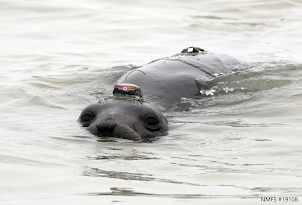
Female elephant seal recording data
(Costa, 2022) 
  

 One marine animal is making a big splash in the scientific community for its assistance in tracking ocean temperature fluctuations using tagged sensors, population data, and migration patterns. The mysterious elephant seals were once some of the most hunted ocean creatures, almost to the point of extinction in the nineteenth century. Their thick layer of blubber was exploited by whalers and hunters and used as an oil source. These animals have made a huge comeback thanks to conservation efforts, awareness, and legal protection, especially in Antarctica and California.

   There are two species of these earless marine mammals, the Northern elephant seal (Mirounga angustirostris) and the Southern elephant seal (Mirounga leonina). The Northern elephant seal is native to California, Baja California, Mexico, and other nearby offshore islands while the Southern elephant seal can be found in sub-Antarctic and Antarctic waters (Moritsch & Lee, 2021). Most elephant seals spend their time breeding on land but living in colder water. Breeding season is an especially intense time for these animals as males fight for dominance and battle to collect a large group of female elephant seals. After the breeding season, they make their way to the water and spend their time migrating in search of food. They spend months at sea searching and diving deep for fish, squid, and similar marine creatures (U.S. National Park Service, 2021).

    Despite defying the odds and repopulating, elephant seals are still left to face the consequences of climate change. As the burning of fossil fuels like coal, oil, and gas continues, marine animals are some of the most affected because they rely on the oceans for their habitat and food. Sea ice provides both a home for aquatic creatures like polar bears, penguins, and seals, but it also affects the temperature of the oceans. Many organisms are being forced to migrate due to warming water; some even have to change their feeding and breeding patterns to acclimate to their new normal. These prolonged water warming events are becoming more common and are referred to as Marine heat waves. The most prolific in recent history is the North Pacific Blob which stretched from 2013 until 2016. It was the longest-lasting and most extensive marine heat wave recorded which caused many elephant seals to migrate toward colder water where they can find better prey. But scientists are using elephant seals to inform the world of the extent of damage done by these heat waves both on the surface and deeper (Wong, 2022).

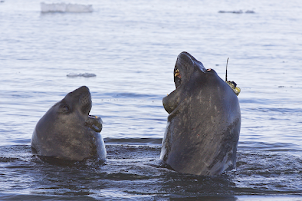
Southern elephant seals with sensors (McMahon, 2016)
    Biologists and ocean scientists at UC Santa Cruz did a study collecting ocean data using tags placed on Northern elephant seals. The seals record depth, temperature, and salinity data that would be otherwise extremely difficult for the researchers to obtain. The seal data collected during the Blob revealed that this ocean-warming event extended deeper into the ocean than once believed, as deep as 1,000 meters below the surface. Marine heatwaves are likely to occur more frequently and severely as temperatures continue to rise worldwide. Understanding these heat waves like the “Blob” will allow scientists to predict their severity, development, and more (Hosler et al., 2022).

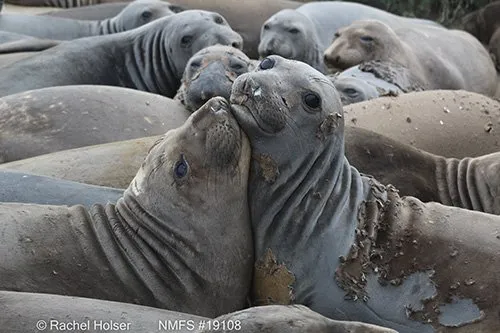
Northern Elephant Seals at Año Nuevo Reserve (Hosler, 2022)
Northern elephant seals are not the only species being used to understand our Earth’s changing climate. In Antarctica, Southern elephant seals are helping scientists track the influence of climate change using sensor-tracking devices similar to the UC Santa Cruz study. Data from the deep diving seals shows that melting ice sheets are disrupting the worldwide food system as the oceans become less salty. This lack of salt is likely affecting the global ocean conveyor belt that transfers heat across the Earth’s seas (McSweeny, 2016). The seals allow scientists to obtain a large range of data patterns as they follow their diverse migration practices. Although once on the brink of extinction, elephant seal populations have bounced back and are now major contributors in allowing scientists to better understand the impacts of climate change on the ocean and marine mammals. 

On September 21, 2022, Ph.D. student Alison Payne presented “Cutting Edge Research on Elephant Seals at Año Nuevo Reserve” at the Marin Science Seminar where she discussed the natural history of elephant seals and the long-term monitoring program at Año Nuevo. Learn more about Alison and her work here.

Works Cited

Herraiz, L. (2016, August 23). Seals help scientists get to the bottom of Antarctic changes. Carbon Brief. Retrieved December, 2022, from https://www.carbonbrief.org/seals-help-scientists-get-to-the-bottom-of-antarctic-changes/

Hosler, R. R., Keates, T. R., Costa, D. P., & Edward, C. A. (2022, July 4). Extent and Magnitude of Subsurface Anomalies During the Northeast Pacific Blob as Measured by Animal-Borne Sensors. AGU Online Library. Retrieved December, 2022, from https://agupubs.onlinelibrary.wiley.com/doi/full/10.1029/2021JC018356

Moritsch, M., & Lee, C. J. (2021). Elephant Seals. National Geographic. Retrieved December, 2022, from https://www.nationalgeographic.com/animals/mammals/facts/elephant-seals

U.S. National Park Service. (2021, May 21). Northern Elephant Seal. National Park Service. Retrieved December, 2022, from https://www.nps.gov/places/northern-elephant-seal.htm

Wong, K. (2022, August 4). Elephant Seals Measure "the Blob" - Natural Reserve System. UC Natural Reserve System. Retrieved December, 2022, from https://ucnrs.org/elephant-seals-measure-the-blob/

Yale Environment 360. (2016, August 24). How Elephant Seals Are Helping Scientists Study Climate Change. Yale E360. Retrieved December, 2022, from https://e360.yale.edu/digest/how_elephant_seals_are_helping_scientists_study_climate_change


Wednesday, September 14, 2022

Fall 2022 Marin Science Seminar Schedule

 Fall 2022 Marin Science Seminar Schedule

Dates: Six Wednesdays per semester, 7:30 – 8:30 pm

Location: Terra Linda High School, 320 Nova Albion Way, San Rafael – 

NEW! Innovation Hub (Park or enter by the San Rafael City Schools entrance, the entrance to the IH is by staff parking, through the courtyard on the 1st floor.) 


Fall 2022 Series


·      Sept. 21: Cutting Edge Research on Elephant Seals at Año Nuevo Reserve with Allison Payne, PhD student at UC Santa Cruz

·      Sept. 28: Video Games, The Metaverse and the Future of Science Educationwith Dane Lancaster of XRMarin and the Marin County Office of Education

·      Oct. 12: Understanding Air Quality Data in the Bay Area with Michael Flagg of Bay Area Air Quality Management District

·      Nov. 9: I’m a Botanist (and unfortunately I don't know why your succulent isn't flowering!) with Sarah Jacobs PhD of the California Academy of Sciences

·      Nov. 16: The Genetics Behind Eye Degeneration in Cave-dwelling Crustaceanswith Meredith Protas PhD of Dominican University, San Rafael

·      Nov. 30: Discovering Drug Therapies for COVID and Long COVID with Art Wallace MD PhD of VA Medical Center SF and UC San Francisco


Important Info.

Masks are required at all Marin Science Seminars this semester. No eating or drinking is allowed in the Innovation Hub. Extra Credit forms and sign-in sheets are available at the events for those attending for credit. There will still be Q&A and discussion. Thank you for your patience and understanding! 

Saturday, August 20, 2022

We're Back! Internship Announcement

We're Back!

Marin Science Seminar is pleased to announce the return of our regularly scheduled six science sessions per semester - in a new, easy-access, well-ventilated venue at Terra Linda High School - the INNOVATION HUB (IH). 

Fall 2022 Internships

Marin Science Seminar internships are only open to high school students living and studying in Marin County, and all interns must be able to physically attend and assist at all seminar sessions from 7 – 8:45pm on session dates.

Explore science & technology. Meet scientists, technologists,  and medical professionals.  Gain experience for your resume and college applications. Develop a portfolio! Learn about many areas of science!

Internship Types & Requirements

  • Science Journalism: Develop a science journalism portfolio. Blog on seminar topics, email interview presenters. Receive training and feedback from a qualified mentor. Must provide two writing samples (need not be science related) and must be able to attend and assist at the sessions. 
  • Videography: Develop a science-related videography portfolio. Record, edit, and post 2D and 3D video of sessions. Create and post teaser videos. Must provide two video samples (need not be science related, YouTube/Insta ok) and must be able to attend and assist at the sessions. 
  • Art/Photography: Develop a science-related art/photography portfolio. Take photos at sessions, create art related to session subject matter. Must provide three art samples (need not be science related) and must be able to attend and assist at the sessions. 
  • AV/Social Media: Develop event-management and/or social media management skills. Social Media interns must have access to Facebook and Instagram. Training provided. Must attend and assist at sessions.
  • MCOE School-to-Career Internship: The first three internship types are potentially applicable to the MCOE StC internship which, when successfully completed, appears on a public school student’s official transcript. Requirements for this internship are more time-intensive and can be found here

Internship Duties

MSS interns attend and assist with  6 Wednesday evening science seminars per semester (there are 12 per year) during which they meet the speakers and assist with various logistical duties. Sessions take place on Wednesday evenings at Terra Linda High School during the school year. Interns arrive the evening of each session at 7 pm and are free to leave once breakdown is completed (between 8:30 and 9 pm). Specialty internships have additional duties during the school year. 

Interns may assist in researching and creating materials about event topics, creating and distributing outreach materials, social networking and online development of Marin Science Seminar’s mission to attract more students to the fields of science, technology and math. Other than attending MSS sessions, duties will depend on student interests and background. Training is provided for some intern tasks. – Start your application online now.

Marin County School-to-Career Partnership Info.

Our specialty internships may also be offered in conjunction with the Marin County School to Career (STC) Partnership. Students attending a public high school in Marin County may apply for StC credit, which, with successful completion of the StC internship requirements, will appear on their official transcript for each semester they intern. Complete and submit a S2C internship application to your school’s School-to-Career representative or visit them at your school’s College & Career Center for the complete packet. Requirements for this internship are more time-intensive and can be found here.

Apply Today!

Our past interns are now students at or graduates of Cal Poly San Luis Obispo, CalTech, Chico State, Harvard, Humboldt State, MIT, Northwestern, Scripps College, Seattle University, Sonoma State, UC Berkeley, UC Davis, UC Irvine, UC Santa Barbara, and UC Santa Cruz. 

Monday, March 23, 2020

"Transportation Research Panel" - An Interview with En-Ya Zhang from the MSEL Transportation Team

by Shoshana Harlem, Terra Linda High School

En-Ya Zhang is a Sophomore at Terra Linda High School. She is part of MSEL's Transportation Team. In order to reduce greenhouse gas emissions in Marin County, En-Ya and her team advocate for people to use public transportation.

1. What made you interested in learning about transportation?

When choosing our topics, all of us saw some improvements that could be made in the transportation system in our community, especially since some of us have ridden MarinTransit or SMART before. In the United States, transportation - cars, buses, trains, planes, trucks, and more - account to the majority of greenhouse gas emissions in the country ( about 29% .) Our overall goal was to try to influence these emissions and make an impact in our community. We wanted to learn about the history of public transit in Marin and use this information to boost public transportation ridership in our community. All of us have had our own experiences riding public transit, in Marin and outside Marin, and these experiences definitely made the topic of transportation more appealing to us. Our exposure to transit system gave us the ability to analyze the faults and disadvantages within agencies in Marin, and brainstorm our own solutions to them. 

2. What interesting facts have you found about transportation?
Overall, our group learned a multitude of interesting facts about transportation, whether it be local or global information. We learned that the Bay Area alone has 27 different transit agencies that do their best to hold up the transportation systems. At one point, there were plans to introduce a high speed rail into California, but these plans fell through due to a lack of sufficient funding and sponsors. MarinTransit, which runs the buses in Marin, has only two electric buses due to their high prices. Originally, Marin County was included in the plans for BART, however, these plans fell through due to a great deal of controversy. Not only did Marin feel like it lacked funding, but many were worried about the idea of setting the tracks under the Golden Gate Bridge, which they believed would ruin the historical landmark. When it comes to more global information, we learned that recently, Luxembourg made all public transit free to its citizens, and Norway's electric vehicle benefits have fueled high buyer rates within the country. 

3. What projects are you currently working on involving transportation research? 
The main project our group focussed on was a policy that we plan to introduce in this community. Throughout the project, we brainstormed a series of different ideas and finally settled on a couple of free fare days that would fall on April 22 (Earth Day), and Election Day. Our group has attended a couple of meetings to plan and finalize this policy, and we have already communicated with MarinTransit. The final task would be for us to present our policy proposal to the MarinTransit Board of Directors, and a meeting date was scheduled. Unfortunately, this presentation has been postponed due to the COVID-19 lockdown, and a new date has yet to be decided. However, we are confidant that we may be able to introduce out policy into the community and have it in action by November of 2020. 

4. How can people utilize transportation in a way that will protect the environment? 
Public transportation is inevitably the most environmentally-friendly transit choice, as it diminished the amount of greenhouse gas emissions per rider. This would include buses, trains, subways, planes, and a few other methods of transit. Agencies try to integrate each mode to make public transportation as efficient and helpful as possible, but its nearly impossible to satisfy the needs of every rider in an entire community. In addition to this, public transportation can sometimes be pricey, or it simply isn't the most reasonable choice to make. For those who are in such a situation and would like to make an impact on emissions, we would suggest carpooling, biking, or walking. Obviously, biking and walking would produce the fewest emissions, however they aren't always the optimal choice, and in that case, carpooling would still reduce the emissions per person, although no significantly.

5. How can we encourage people to walk and bike more to places?
We learned from Norway's electric vehicle policy that oftentimes, the most effective way to influence the public's decisions is to provide them with benefits. For many, walking and biking from Point A to Point B isn't worth the extra time of the extra effort. That is by far the biggest obstacle when it comes to promoting such habits and transportation methods, especially when it comes to commuters that have to travel miles everyday. Such people would benefit more from riding public transportation, as it fits better with their daily schedules and needs. However, in school zones, there is much to be done to increase the use of bikes and the number of walkers. Many schools already have special days set aside to promote these modes of transport, and encourage it by handing out prizes. However, increasing the sizes of the bike lanes could make it more prominent in our community, as many parents might be worried about the safety of their children. This would provide bikers with more space, and could increase the number of students that ride their bike to school instead of private vehicles. 

Interview with Irfan Kathiriya: How to Make or Break Your Heart

By: Sahiti Namburu School: Terra Linda High School Dr. Kathiriya is a pediatric cardiac anesthesiologist and Professor of Anesthesia at t...

About Us

Marin Science Seminar is a one-hour science lecture/presentation with a question and answer period open to all interested local teenagers, educators and community. Seminar sessions are held 12 Wednesday evenings during the school year, from 7:30 to 8:30 pm in the Innovation Hub at Terra Linda High School, 320 Nova Albion Way, San Rafael. Seminar speakers are scientists, mathematicians, engineers, physicians, technologists and computer programmers. The topics presented are in a specific area of the speaker’s expertise, geared to interested high school students.