Showing posts with label astronomy. Show all posts

Thursday, August 10, 2023

A DeepDive into BioAstronautics and Space with Ben Foehr

By Disha Divakar, San Marin High School


Whether it was as kids pretending cardboard boxes were space shuttles or being fascinated by Star Wars, spaceflight has been a dream for many! In reality, we often forget the factors that have to be thought through when sending a human to space and a lot of times we don't always know of the infinite mysteries and possibilities the galaxy holds! In this interview, Ben Foehr (
BS in Aerospace Engineering and Grad Student studying Human Spaceflight at CU Boulder) dives more into his work and emphasis on Bioastronautics and Aerospace engineering and addresses some questions as we enter a new age of space exploration! Ben presented Path to the Stars: Exploring Bioastronautics for the Marin Science Seminar on February 15th.

Fun Fact: He has worked on Cubesats, Sounding Rockets, and proprioceptive function research for astronauts

Ben Foehr


Right 
now, what is the most important question/problem that you are trying to answer and solve?
In my opinion, the biggest issues in Bioastronautics are the issues faced by Astronauts on long duration space flights. Space is an incredibly hostile environment even for short visits, but the longer we stay in outer space, the more our bodies are negatively affected. Extended microgravity leads to things like bone loss, muscle atrophy, and vision problems, while the constant noise and high stress environment found aboard spacecraft and space stations lead to most astronauts having really messed up sleep schedules for months on end, and having to fight through a bunch of different types of fatigue to get any work done. And that's just for Earth orbit: the further out we go towards places like the Moon or Mars, the more of an issue things like isolation from support and deadly radiation becomes, which is its own set of huge issues! So, overall, a lot of my field's focus is on figuring out how the heck we'll be able to keep all our astronauts happy, healthy, and productive when we start living in space for more than just a few weeks or months.

What particular factors do you consider when sending a human through space flight? How do you develop the right conditions for a human to travel in space for long periods of time?
For spaceflight, we start by considering all of the parts of our environment here on Earth we have to bring with us into space for our crew to survive: an atmosphere we can breathe, food we can eat, water we can drink (then recycle and drink again). We also have to think about less obvious parts of our everyday environment, like what tools and skills a crew will need to conduct their mission successfully, or what unexpected factors might make things more complex, like how we'd deal with a surprise medical emergency, or sudden tensions between the crew. Luckily, the best way to prepare for these missions is to look at previous missions: we've sent around 628 people to space so far, and while that a very small number of data points for most scientific studies, all of these previous explorers can tell us a lot about what worked on their mission and what didn't, so we can prepare for how we want to do things different next time. The ISS has been especially helpful, as crews staying abroad for 6 months or more will give a LOT of feedback about how they felt in terms of physical and mental health, their ability to get their job done, and what they would have liked to have during their stay to make things better.

What was the most influential project you have worked on?
So far, the most influential project I've ever worked on was a week-long design workshop hosted by the ESA and the University of Stuttgart out in Germany. There, I was one of only two Americans invited to work with a group of 40 other college students from all across the world who were interested in space exploration to design a realistic and workable concept for a space station that could be built some day in the near future. Obviously, designing a space station like this was incredibly cool and exciting, but in my opinion, working with an international group like this really opened my eyes to the different ways people all over the planet engage with space exploration, and I was able to make some lifelong friends in the process! It was a ton of work, and I didn't sleep much that week, but I came out of it more excited about my field than ever before.

Do you think it is going to be necessary for humans to relocate to a new planet soon? When do you think Earth’s conditions will become inhabitable/unsuitable for us?
This is a question I hear often, and I totally understand why a lot of people think leaving the Earth might be our only option. As climate change worsens and our planet begins to suffer from the effects of pollution, it often feels like fleeing to the stars and finding somewhere safe where we can survive might be our only chance to survive. But space is an incredibly inhospitable place, and keeping just two or three humans alive on places like the Moon or Mars even for a few days is a really, really difficult task, so with current technology it's basically impossible to strike out in search of a new home. But this doesn't mean we should give up hope: humans are incredibly resilient, and just the fact that we're even able to send people off-world for long periods of time is proof that we can adapt to harsh environments and overcome incredible problems! I think one day we will see humans living on another world, but, in my opinion, I think something like that will only ever be possible once we figure out how to fix our problems on Earth. But I believe in us, and think we will be able to pull it off! And after that, as they say, I think the sky's the limit!

Will space exploration start affecting everybody’s life and become a normality/reality for people other than astronauts?
I think space exploration already does affect everyone's life down on Earth, it's just hard to see sometimes. A lot of technology we use everyday like GPS, compact computers, Solar Panels, and even velcro was developed for space exploration, and current missions are helping innovate and create new and exciting technology. In terms of traveling to space, I also think that's something we'll see more and more of: right now it's fairly exclusively either rich tourists or highly selected scientists, which is generally out of reach for regular people. But as more nations and organizations travel out into space, more people will go too, and it would not surprise me that, within the next 100 years, we see space exploration more as people saw sailors on old exploring and trading ships: a rough lifestyle and still a fairly exclusive group, but something regular people could, with the commitment, become a part of. And beyond that, I one day hope that everyone can go to space as easily as going on any other trip, or moving to any other place on Earth!

What are your hopes for the future of space exploration? What do you want to see?
There is a lot I hope to one day see in regards to space exploration, but my number one dream would be to see us explore space and live on new worlds in a way that shows improvement for humanity beyond what we've done before. Back during the Cold War, for example, even though tensions were extremely high between the US and the Soviet Union, the joint Apollo/Soyuz mission in 1975 saw the two "opposing" crews quickly become fast friends, bonding over their shared humanity and love of exploration! In the future, I hope to see more events like this, where different people from different nations, creeds, and backgrounds can still explore space under common goals. I'd love to see, for example, international collaboration on Moon and Mars missions not just with NASA and ESA, but other space agencies like the Chinese National Space Administration, or the Indian Space Administration, or any other nation that wants to be a part of this journey. If we want to go to the Moon, Mars, or beyond, we need to go together, and I hope to one day see that become reality.

Sunday, March 15, 2015

Interview with Steve Croft, Ph. D. on Black Holes

By Angel Zhou, Branson School


Black holes. Don’t let the name fool you: a black hole is anything but empty space. Rather, it is a great amount of matter packed into a very small area. Scientists can't directly observe black holes with telescopes that detect x-rays, light, or other forms of electromagnetic radiation. They can, however, infer the presence of black holes and study them by detecting their effect on other matter nearby.

Steve Croft, an astronomer at the University of California, Berkeley, uses a new radio telescope, the Allen Telescope Array to study. He grew up in England, where he received a PhD in astrophysics from Oxford University in 2002, before moving to California to work as a postdoctoral researcher at the Lawrence Livermore National Laboratory.

Read the following interview to learn more about Dr. Croft’s life and work as an astronomer.  


Steve Croft, Ph. D.


1) How did you decide to enter your field of work?
I've always been fascinated to understand how things work. We're all born scientists and explorers at some level. Even as babies we learn about the world around us by trying things out, taking things apart, and performing experiments. I got particularly interested in space when a neighbor bought me a book about astronomy when I was probably about eight years old. My parents bought me a small telescope at about twelve that I used to look at craters on the Moon and the rings of Saturn. I continued to read astronomy books and watch astronomy TV shows, as well as being fortunate to learn math and science from some great school teachers.

I chose to study astrophysics for my undergraduate degree at University College London in the UK, and particularly enjoyed hands on experience with large telescopes at the University of London Observatory. That really confirmed for me that I wanted to be an observational astronomer, so I ended up doing a PhD at Oxford University, using some of the world's largest telescopes to study the growth and environments of supermassive black holes. I moved to California in 2002 and worked at the Lawrence Livermore National Lab for 5 years where I was a member of a small astronomy research group. I got to use the Keck Telescopes in Hawaii - the largest optical telescopes in the world - as well as the Hubble Space Telescope and many others. I've been at Berkeley since 2007, and I'm currently working on one of the most cutting edge radio telescopes in the world as part of a big international team. 


2) Describe your typical day at work as an astronomer. What are your favorite and least favorite parts of your job?
I travel a lot for work. I just got back from a month in Australia. I spent most of the time there working with colleagues at the University of Sydney, but I also traveled to Melbourne for a couple of days to give talks, as well as out to the site of the telescope I'm working on, in the remote Australian outback. Last year I traveled to South Africa and Italy for conferences, as well as several trips within the US for meetings. The travel is one of my favorite parts of the job. Meeting new people and exploring new ideas, as well as seeing new places, are important to me.

When I am in the Bay Area I go into the office most days, although sometimes I work from home or have meetings offsite. I work in a regular office which I share with another astronomer. Most of my work is done using an iMac computer with two big screens, but I log in remotely to more powerful computers (including one with 256 GB of RAM and many TB of storage) to analyze the data from the telescopes I'm using. More often than not I'll have a meeting or two, or attend a seminar. Sometimes I'll have informal discussions with colleagues over lunch. I read papers written by other astronomers to keep up on research in my field. I also do a lot of education and outreach programs, including working with high schoolers. Last year we launched two high altitude weather balloons with GoPro cameras attached to the edge of space. That was really exciting.

I guess my least favorite part of the job is that I always have so much going on, including a ton of emails waiting for me to respond to. It's great to be in a job that's stimulating but sometimes I feel like I will never get to the bottom of my to-do list.


4) What are black holes and why do they play an important role in the universe?
There are two main varieties of black holes. One kind is about the same mass as our Sun. These result from the violent deaths of massive stars. There are probably millions of these in our Galaxy. The other kind, the ones that I research, are supermassive black holes that can be millions or billions of times as massive as the Sun. These monsters lurk at the centers of galaxies, typically only around one per galaxy, and we're starting to understand that the way they get to be so big has a profound influence on the galaxies themselves. The forces that they produce are so incredibly powerful that they can rip stars apart and send out blast waves that shape the gas and stars that make up the galaxies in which they live.


5) What aspect of black holes are you particularly fascinated by and why?
One thing that I'd like to understand better is why some black holes lurk around not doing very much, sometimes for billions of years, and then switch to violent phases of growth. Understanding how they launch jets of material moving at close to the speed of light, and how collisions of black holes disturb spacetime itself, are areas of active research that I hope we'll get closer to understanding with the new generation of telescopes that we're building.

Join us on Wednesday, March 11th for Steve Croft’s seminar, "Snacking, Gorging, and Cannibalizing: The Feeding Habits of Black Holes" of UC Berkley in Room 207 at Terra Linda High School in San Rafael. For more information, visit Marin Science Seminar's Facebook page: https://www.facebook.com/events/1540138222921928/.

Sunday, March 8, 2015

Expanding Horizon: How Black Holes Grow

By Talya Klinger, Homeschooler

Contrary to popular opinion, black holes do not exist solely to swallow up your socks, keys, and the last scoop of Rocky Road you were saving for a late night snack. Rather, a black hole is an object with such a large mass in such a small volume that nothing, not even light, can escape its gravitational pull. The black hole’s gravitational pull absorbs whatever is in its reach.

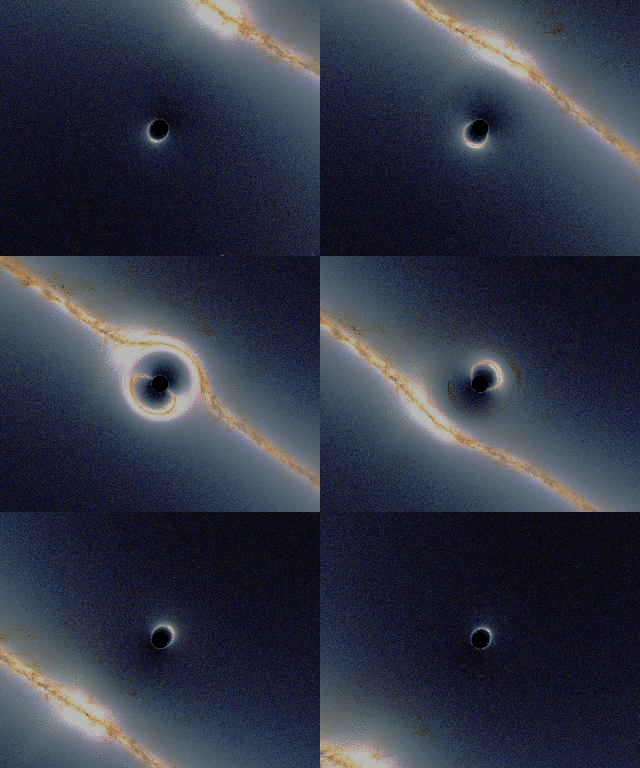
The outer limit of a black hole is an imaginary surface called its event horizon, where the black hole's gravitational pull is just strong enough that not a single photon can escape, creating a large dark space. According to Einstein's theory of general relativity, even light rays that pass by the event horizon are bent and distorted by the black hole's gravity in a process called gravitational lensing. 

This simulation of a spinning supermassive black hole from the movie Interstellar is approximately what a black hole would look like, according to general relativity.


As black holes absorb more and more objects, their mass grows. Not all black holes grow to a similar size, however. Depending on their mass, black holes generally fall into two radically different size categories: stellar mass and supermassive. Most stellar mass black holes, which are 10 to 24 times the size of the sun, are isolated and difficult to detect. Supermassive black holes, on the other hand, are millions or billions of times the size of the sun and are found at the center of most large galaxies, such as the Milky Way. Even when supermassive black holes are not absorbing matter, scientists can observe the effects such black holes have on the stars and gases around them. While stellar mass black holes are more difficult to detect unless they are in the process of absorbing matter, scientists know more about how they form than they do about the formation of supermassive black holes.

 
A simulation of gravitational lensing around a black hole and a galaxy

Many of the properties of black holes are well documented, yet the formation and growth of supermassive black holes are on the cutting edge of astrophysics. Black holes usually form out of supernovas – the explosions at the end of a star's lifespan. In young or middle-aged stars, the energy created by nuclear fusion counteracts gravity, and keeps a star from collapsing into a black hole. When a massive star reaches the end of its lifespan (when it has burned all the fuel inside of it), it explodes in a phenomenon known as a supernova. Because fusion cannot occur in the remnants of a supernova, when there is not enough energy for the supernova to counteract gravity, there is nothing to prevent the remaining matter from collapsing into a dense object, such as a black hole. By astronomical standards, only supermassive stars have enough matter to become black holes, so small stars, including our sun, merely compact into white dwarfs or neutron stars. (Spoiler alert: the sun will eventually become a white dwarf, so there is no danger of it becoming a black hole.) Scientists know more about the creation of stellar-mass black holes than about the creation of supermassive black holes, but there is a possibility that stellar-mass black holes can grow to a supermassive size by rapidly consuming the matter around them.

Once a black hole forms, it can continue to grow by absorbing more and more matter. The following is theoretical. For example, in binary star systems containing two large stars, the first star to become a black hole will absorb matter from its companion star until the younger star vanishes. When black holes are too far from stars to absorb their matter, they consume the dust and gas floating around them. When two black holes collide, it has been hypothesized that they merge together to become an even larger black hole, producing a whopping amount of energy and sending ripples known as gravitational waves through the universe. 
 A stellar-mass black hole in a binary star system

So far, the only observations of gravitational waves have been contradicted by other, more detailed observations. However, as pairs of supermassive black holes at the centers of distant galaxies spiral closer and closer to each other, the chances are good that we will eventually be able to observe and study such dramatic black hole growth.

In the upcoming Marin Science Seminar, "Snacking, Gorging, and Cannibalizing: The Feeding Habits of Black Holes," astrophysicist Steve Croft, Ph.D. will discuss how innovative telescope technologies make it possible to observe the growth of black holes in a new way, and perhaps, track disappearances from laundry baskets, tables, and refrigerators once and for all

For more information, come to the next Marin Science Seminar at Terra Linda High School from 7:30-8:30 p.m. on March 11th, 2015.

Sources:
Image Credits:

Wednesday, May 21, 2014

Mission Control with Jay Trimble

by Gillian Parker, Tamalpais HS         

Have you ever wondered what happens down at mission control? Who supports astronauts from below? Jay Trimble leads the User Centered Technology Group at NASA Ames Research Center (NASA-Ames Website). The UCT Group is a collection of people with various specialties from  anthropology to computer science that work together to create software for mission control. Jay also led another team called Mars Exploration Rover Human Centered Computing Project, which worked on Mar Rover Operations. Read the following interview with Jay Trimble to find out more about mission control.

Jay Trimble

1. What are some of the projects that the User Centered Technology (UCT) Group at NASA Ames Research Center has worked on?
The UCT Group has focused on component software that allows users to build their own software with compositions, meaning users can essentially assemble their own software using drag and drop. The software is open source, it’s called Open Mission Control Technologies. You can learn more about the software at http://ti.arc.nasa.gov/OpenMCT/, or on GitHub at https://github.com/nasa/mct. The UCT group has also built software to assist scientist in archiving planetary science data. 

2. What is the process of making software at the UCT Group like?
The process for making software is focused on the users. We use a range of methods to connect with users and translate what we’ve learned into the design of the software. We observe users doing their work in their own environment. This is important because observing users gives you a perspective that you won’t get by talking to them, though talking to users is also important. We interview users as well to better understand their work. We develop prototypes and iteratively improve them. Ideas are communicated and tested visually before committing to code. 

3. How did the Mars Exploration Rover Human Centered Computing Project improve the process and technology of Mars Rover Operations?
For Mars Rover Operations we worked with the Jet Propulsion Lab (JPL). We were part of a team looking at science processes. We developed software that ran on large touch screens that allowed the scientists to plan several days out what they wanted to be doing. 

4. What are your favorite/ least favorite parts of your job?
My favorite parts of my job are being part of space exploration and the people I work with. My least favorite part of the job is the uncertainty of the federal budget process. 

5. What do you see in the future of the UCT Group, and space-related technology in general?
That’s a very broad question. My group is working on a Lunar Rover Mission to conduct surface exploration in polar regions to prospect for water and other resources. That’s our focus at the moment. We are also continuing to work with JPL on software for monitoring solar system exploration spacecraft. I think space technology in general in focused on moving us beyond low Earth orbit and out into the solar system. 

6. How did you decide your career path?
I decided my career path based on my interest in the space program that began in grade school when we were landing on the Moon. 

Come to the Marin Science Seminar on Wednesday May 21 at Terra Linda High School, San Rafael; Physiology Lab 207 from 7:30-8:30 to learn more

Tuesday, March 26, 2013

The Birth of the Universe, through Today's Telescopes

by Sandra Ning, Terra Linda HS

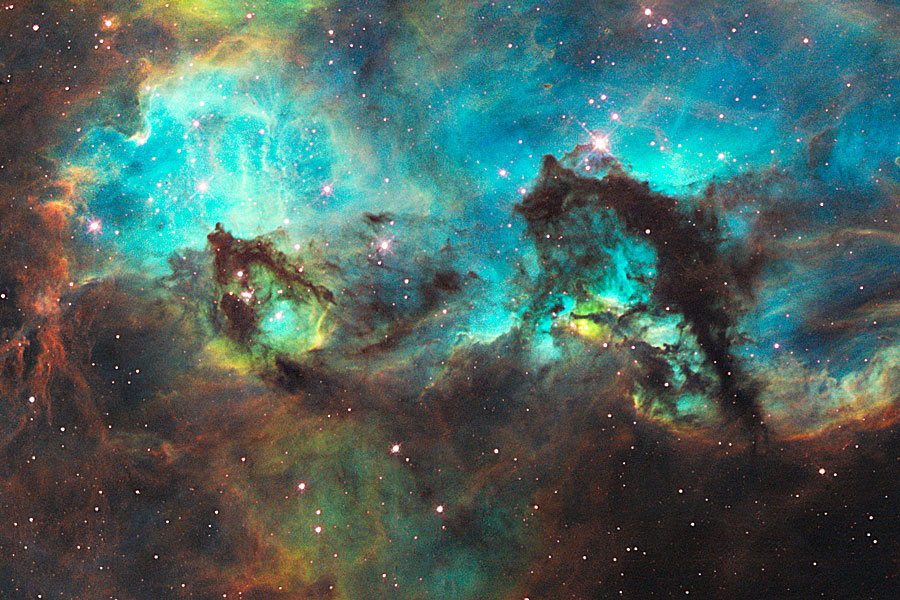
A nebula in the Large Magellanic Cloud. Though nebulae are often the focus of space appreciation in pop culture, the universe encompasses billions more phenomena.

     A story is typically told from the beginning, but oftentimes the universe is an exception. As a society, time is measured in days and nights, hours, minutes, and seconds. But even more so, time is apparent to us through the peachy sunrise of dawn, the angry grumbles of an empty stomach at noon, and the fatigue that settles with the darkness of night. It's hard to imagine any of these things in relation to the universe, with its sleepless planets and nomadic asteroids, all swallowed up in an unimaginably large blanket of space. If the universe is a story, and all the galaxies, comets, and stars its characters, where does it all begin? 
     Luckily, scientists have already delved into the origins of the universe, and have resurfaced with new and exciting insights regarding these questions. Dr. Mary Barsony, an associate professor of physics and astronomy at SFSU, has kindly answered several questions regarding the birth of the universe, the elements, and how scientists are researching it all.--

1. The Big Bang theory is the most widely-accepted theory for the creation of the universe. What kind of evidence have astrophysicists gathered to support this?


    a) Apart from the "immediate" neighborhood of our Milky Way Galaxy,
in any direction you look, the further away a galaxy is, the greater the shift
of its spectral lines towards longer wavelengths (e.g., towards the red portion of the spectrum, hence the term "red-shifted.") This systematic red-shift of extragalactic spectra
was first discovered nearly a hundred years ago, by combining spectra obtained
by V.V. Slipher at Lowell Observatory with distance determinations obtained by
E. Hubble at Mt. Wilson Observatory. 


           Any cosmological theory must explain this observational fact. According
to the Big Bang theory, the observed red-shifts are a direct consequence of
the expansion of the Universe since the Big Bang (13.7 billion years ago).
As space(time) expands, the light-waves stretch with the space they are in,
meaning their wavelengths get longer, or red-shifted.


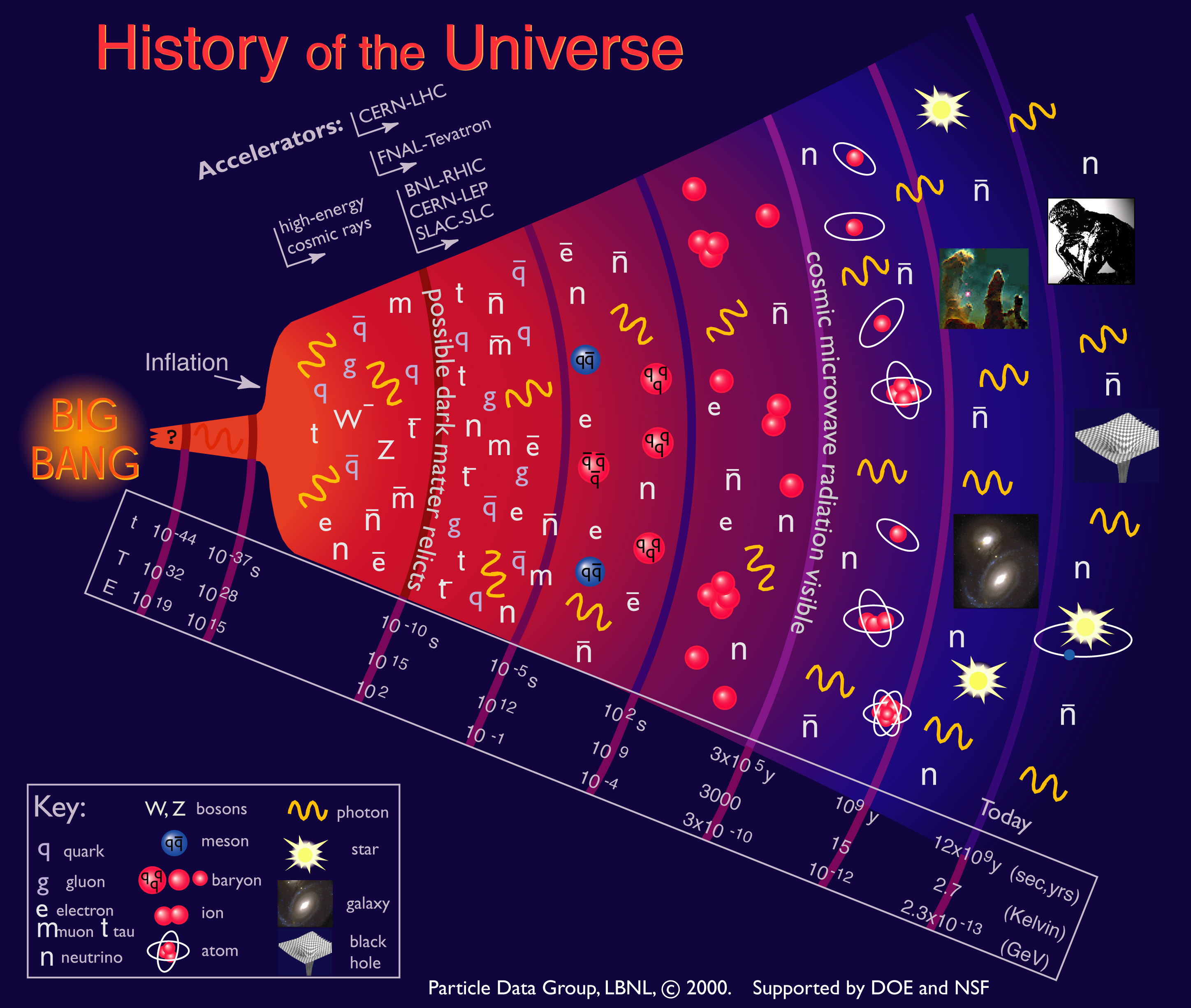
 Timeline of the universe, showing the formation of particles, then nebula, then more.


     b) There is remnant radiation observed in all directions of space, corresponding
to a temperature of 2.73 Kelvins (above absolute zero), peaking at a wavelength of
~1 millimeter, which is in the "microwave" region of the electromagnetic spectrum.


         Any cosmological theory must explain why we see this radiation uniformly
in all directions in the sky.  According to the Big Bang theory, early in the
Universe's history, its state was extremely hot and dense--so hot that
protons and electrons were separated from each other in a state
known as a "plasma." Photons (light) cannot escape such a plasma,
since photons strongly interact with free electrons and protons. This
interaction is called "scattering."  As the Universe expands, it cools. Once the Universe
had expanded and cooled enough so that protons and electrons
could combine to form atoms, the plasma turned into an electrically
neutral state, and the photons could escape--so instead of a dense, opaque
fog of scattered photons, we have a transparent state of freely propagating photons (light).
The microwave background radiation was discovered (accidentally) by some radio
communications engineers (as a source of unwanted noise in their communications
equipment). They received the Nobel Prize in Physics for their discovery.


    c)  We observe the elemental abundances in the Universe to be
~90% (by number) hydrogen and ~10% (by number) helium.
In terms of mass, this corresponds to ~75% by mass of hydrogen and ~24% by mass
helium. All the other elements we are familiar with here on Earth are trace
elements relative to these, on the scale of stars, galaxies, and galaxy clusters.


      The abundances of hydrogen and helium are predicted by the Big Bang theory
in terms of what is known as "Big Bang nucleosynthesis."


2. Did all of the elements form at once with the Big Bang? And if not, in what order (if any) did they form in?


      The nucleon formation order in the Big Bang was: protons (protons are nuclei
of hydrogen) and neutrons, then deuterons (the nuclei of deuterium or heavy
water), then helium nuclei (both "light" helium, with  2 protons+1 neutron and "regular" helium, with 2 protons + 2 neutrons), then lithium. All the tritium nuclei (12 yr half-life) and beryllium nuclei (53 day half-life) formed in the Big Bang decayed into deuterons or lithium.
  
          All other elements are formed either within massive stars, post-main-sequence stars, supernovae, or spallation of cosmic particles and interstellar hydrogen nuclei (protons).


3. Would it be theoretically possible to create even more elements?


       Yes, elements past uranium, the so-called "trans-uranium" elements
are all formed in the lab with accelerators. Generally, these very heavy
elements are unstable and decay (their nuclei split apart, or undergo "fission")
in fractions of a second.


4. What elements are "stardust" and nebulae primarily composed of? 


    Interstellar dust is mainly composed of silicates and hydrocarbons.


     Nebulae are generally gas lit up by a nearby light source, which could be
a massive star or star cluster (e.g., Orion nebula) , a white dwarf (planetary
nebulae), a pulsar (Crab nebula), or very young star  (L1551 in Taurus).
Interstellar gas is primarily composed of hydrogen and helium, with  traces of
other, heavier elements.


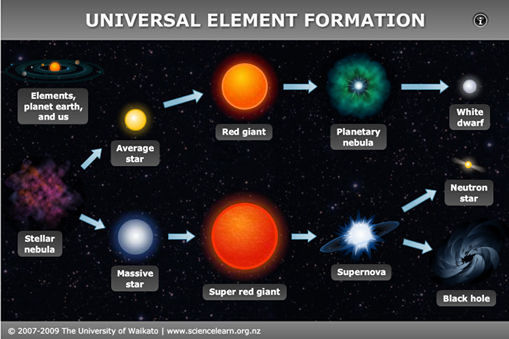
A flowchart of star formation; protostars aren't shown in this chart, but would be between the stellar nebula and a fully-formed star.


6. What are neutron stars?

       A neutron star is an object made entirely of neutrons, that has a radius of ~10 km
and contains more than 1.4 solar masses.  Generally, it is a remnant of a
supernova explosion.

7.  And what are protostars?

       A protostar (of which I am one of the co-discoverers) is an object
which is still in the process of forming, with almost all of its mass residing
in an extended (~2000 Earth-Sun distances, or astronomical units) infalling envelope.
Its energy is derived from gravitational infall, and it fuels powerful bipolar
jets of gas, which act to remove its magnetic field and spin energy.


7. You're currently studying a protostar, the Wasp-Waist Nebula, right? What do scientists hope to learn from protostars, and for what purposes?


    Fantastic! You saw it! Yes, this nebula is mostly composed of hydrogen.
The protostar forming at the center of the Wasp-Waist Nebula may be the
first such object we have found that ultimately may form into a "failed star"
or "brown dwarf" (an object not massive enough to fuse hydrogen into helium
in its core) instead of into a low-mass star.


        We're hoping to understand, in detail, both how stars form from the
tenuous interstellar medium and how their planetary systems form.


The Wasp-Waist Nebula, which holds a protostar currently being studied.


8. Do orbiting planets form already orbiting a star? Or do they form, and then drift in space until a sizeable star is encountered?


     Actually, as stars form they form accretion disks, as well. Just like when
water goes down a drain, it generally swirls around before going down the center,
so gas and dust swirl around in a disk around the central protostar before falling in.
Planets eventually form from the disk orbiting the central young (pre-main-sequence,
or, not yet fusing hydrogen to helium) object.


9. Why are the outer planets all gas giants while the inner planets are all rock?


      That has to do with the temperature structure of the accretion disk
around a young, pre-main-sequence object. It's so hot close-in that only
rocky (silicates, iron) planets can form from planetesimals crashing into each other--it's too
hot for ices to form. Remember that, by far, most of the material in such
a disk is hydrogen, then helium, with just traces of heavier elements.


   Far enough out in the disk, the temperature cools enough so that both
ices (composed of water, carbon monoxide, ammonia) and rocks (silicates)
can form the central cores of planets. Once an icy/rocky core
surpasses about ten Earth masses, its gravitational pull can become
strong enough to hold onto and sweep up the disk's gas in and near its orbit.
This is how the gas giants Jupiter and Saturn, and the ice giants, Neptune and
Uranus, formed.


10. Is it difficult to study the formations of stars and planets? What obstacles are in the way of studying these formations?


       Yes, it's difficult, but it's rewarding. We are very lucky to live in the present
time, when our technology is allowing us to examine star and planet formation
in unprecedented detail.  The ALMA (Atacama Large Millimeter/submillimeter Array)
will revolutionize our understanding of this field.  This instrument (66 telescopes
working as one) was just inaugurated, on March 13, 2013.  https://science.nrao.edu


11. What kind of technology are scientists using to study these formations?


    Very many kinds. The ALMA array, for instance, uses the fastest, specially
made supercomputer (called a "correlator") to process the signals from
all of its antennas simultaneously every 10 seconds. The receivers for
detecting radiation from the sky are state-of-the-art and are approaching  (or at) the
quantum limit for how faint a signal they will respond to. Its data processing
software and user interface is brand new and continually being written and upgraded.
This is a truly international collaboration, with scientists from Europe,
North America, Taiwan, and Japan all equal partners in its use and development.


     For near-infrared arrays, to find new brown dwarfs
and young free-floating planets, we're using the largest such devices in existence.
For near-infrared spectroscopy, we're using a 400-fiber-optic fed
spectrograph (called FMOS) on the Subaru 8.0-meter telescope on Mauna Kea.
for a recent synopsis of this work).


     We're looking forward to JWST, the successor to Hubble, which will
work in the near- and mid-infrared. That is where we can study star and planet
formation much better than at optical wavelengths, where these objects
are generally invisible.


  12. How do SETI scientists try to find life in the universe?


  Currently, they are using the ATA (Allen Telescope Array),
looking in a specific frequency range (1-10 GHz) for
narrowband signals that might be transmitted by other


   SETI scientists are also studying geology, geophysics, atmospheric
science, and the conditions under which life may first have arisen on our own planet.
They are studying life in extreme environments on Earth, as in under the Antarctic
ice sheet and on the deep ocean floor where sunlight does not penetrate, and pressures
are high, etc.


13. You're very involved in different fields of astrophysics; how did you realize your interest in astronomy?

   I remember as a little girl of 4 or 5 years old, looking up at the dark sky, seeing the
stars, and wondering.

The night sky over the Church of Good Shepherd; New Zealand tried to get this patch of sky named a World Heritage Site.
 
--

Come join the Marin Science Seminar during our Astronomy Month presentations! This Wednesday, March 27, Dr. Mary Barsony will be presenting 'We are Stardust: Genesis of the Elements'. The Marin Science Seminar takes place from 7:30 to 8:30 p.m., in rm. 207 of Terra Linda High School.

--

Sandra Ning

Wednesday, July 22, 2009

Aug. 10, 2009 - Field trip to Atlas Cafe "Down to a Science" Science Cafe

From the Down to a Science website. Join us! You can RSVP at the Facebook event page here or by sending me an email at marinscienceseminar@gmail.com.


When: Monday, August 10th 7-9 PM
What: Confessions of an Alien Hunter
Where: Atlas Cafe, 3049 20th St @ Alabama St. in the Mission District
Who: Seth Shostak, Senior Astronomer, SETI Institute, Renowned Alien Hunter
The Deets:
Why do we think aliens are out there? Is Earth really being visited? Will aliens really be short, gray, and hairless? What happens if we pick up a signal from another world?

These are just a few of the questions this month’s guest, Seth Shostak, tackles regularly in his role as the senior astronomer for the SETI (Search for Extra-Terrestrial Intelligence) Institute. Shostak will also discuss the beginnings of life on earth, how this knowledge impacts what astronomers search for in other galaxies, and the growing consortium of scientific voices who believe "it would be offensively self-centered to imagine that what has happened on Earth has only happened on Earth."

Interview with Irfan Kathiriya: How to Make or Break Your Heart

By: Sahiti Namburu School: Terra Linda High School Dr. Kathiriya is a pediatric cardiac anesthesiologist and Professor of Anesthesia at t...

About Us

Marin Science Seminar is a one-hour science lecture/presentation with a question and answer period open to all interested local teenagers, educators and community. Seminar sessions are held 12 Wednesday evenings during the school year, from 7:30 to 8:30 pm in the Innovation Hub at Terra Linda High School, 320 Nova Albion Way, San Rafael. Seminar speakers are scientists, mathematicians, engineers, physicians, technologists and computer programmers. The topics presented are in a specific area of the speaker’s expertise, geared to interested high school students.