Showing posts with label genetics. Show all posts

Friday, January 27, 2023

Designer Babies: Where Do We Draw the Line? Featuring Liya Rabkina

 Disha Divakar, San Marin High School

Dog breeding is a well-known process in which certain favorable traits and characteristics of dogs are chosen over others. Over time, people have realized that all dogs are valuable and just as amazing as others even if they come in different shapes and sizes. People have even acknowledged that this type of selective breeding results in unhealthy generations and leads to non-purebred dogs being looked down upon. Similar to this situation exists the developing process of preimplantation genetic testing, PGT for short, and the creation of what we call “Designer Babies”.  PGT testing is a developing platform that advances pregnancy opinions and tests for many different conditions. There are three types of PGT-testing: PGT-A to test for aneuploidies, PGT-M to test for monogenetic conditions, and PGT-P for polygenic conditions. It does, however, come with a fair share of ethical concerns.


Featured in this essay is the perspective of a genetic counselor, Liya Rabkina. Rabkina is a licensed and board-certified genetic counselor who is currently working at Igenomix USA in SFO. She holds a B.A. in Biochemistry from Scripps College and M.S. in Genetic Counseling from Northwestern. Through an interview and presentation, she provided insightful information regarding the science of designer babies and the ethics surrounding them.

PGT testing is a novel way to help struggling parents get a better look at their pregnancy. Sometimes families have an increased chance of passing on inherited diseases and conditions to their offspring that may threaten the baby’s life and the pregnancy itself. These can include Down Syndrome, Turner Syndrome, and Klinefelter syndrome.  PGT testing helps to test for such conditions. PGT is used in conjunction with in vitro fertilization (IVF) to keep the embryos with the highest chance of survival and the ones with the lowest risks of certain genetic diseases. PGT testing can also be used for the testing of risks of polygenic conditions such as diabetes. One might ask how ethical it is to simply discard embryos that only have a possibility of an inherited illness and may not even be life-threatening.

PGT-A is the more typically used form of PGT testing. PacGenomics, a clinical genetics laboratory, says,” PGT-A, preimplantation genetic testing for aneuploidies, is a genetic test performed on embryos created through IVF to screen for chromosomal abnormalities.” PGT-A is specifically to screen for aneuploidies which are generally related to either an excess or loss of a chromosome. According to Igenomix, PGT-A testing helps decrease the chances of miscarriage, increase pregnancy rates, and provides a greater chance of successful implantation. The detection of these abnormalities helps parents exclude embryos with aneuploidy and keep those with the highest success rate. It is understandable how patients would desire an option like this after they struggle with pregnancy. While PGT-A testing may open doors for some, according to the Pacific Fertility Center of Los Angeles, “PGS/PGT-A testing is typically performed during the IVF procedure, which can cost anywhere from $10,000 to $30,000 without a third-party surrogate or egg donor.” Thinking about this, it is clear that the process is no piece of cake. IVF treatment itself is known to be quite long and expensive due to the number of cycles needed to have a successful embryo. So adding a new test, PGT-A, on top of this already complicated process, can add a lot more tension and stress to a family. Liya Rabkina also wishes that people understood the practicality of this process and success as “there are often far fewer embryos than couples are hoping to have available for transfer.”. Another idea to keep in mind is that PGT-A testing can also be used for sex selection which can present ethical and social problems discussed later. Nonetheless, PGT testing can provide IVF patients with a better shot at a viable pregnancy while some families may be left with a lack of resources and embryos!

Another common form of PGT testing is PGT-M which tests for monogenetic, single-gene diseases. This is generally done when families are aware of a specific genetic condition that spreads in the family and want to test for that specific gene in the embryos. Examples of single-gene diseases include cystic fibrosis, breast cancer, sickle cell anemia, and Huntington’s. These diseases are rare and potentially devastating so it is crucial for families to know how they can prepare themselves and possibly prevent these types of inherited conditions.

Both PGT-A and PGT-M show to test for life-threatening and drastic conditions and both are likely to be on the more immediate and life-long side. On the other hand, a more newly emerging technology known as the PGT-P test for polygenic conditions. This testing shows a possible risk that may develop over time. PGT-P tests for conditions like diabetes, heart disease, and asthma. Generally, as mentioned before, these are more of a risk and develop rather than immediately devastating or threatening the life of the child. While these conditions may still be harmful in the long run, it may be unethical to discard these embryos based off of a non-life-threatening risk. More importantly, these eggs are still viable as well which provides another consideration when it comes to discarding them due to the discovery of a future common risk.  Aside from health conditions, it can also test for polygenic traits which include height! This can be considered unnecessary when considering the viability and health of an embryo.

Focusing on ethics, many perspectives can be looked at. Even genetic counselors take the role to place checkpoints and make ethical considerations when offering these tests to ensure that they are truly needed. Rabkina stated, “My team screens all referrals and discusses ethical concerns with the ordering clinician. We may even reject a case if our ethics committee believes we should not move forward with testing. That being said, I also use my clinical judgment when I speak with patients, even for cases that pass our ethics evaluation and are approved by the ordering clinician. I provide patients with information that can help them make the decision that is best for their family.” This is because it is understood that discarding eggs simply based on possibly viable chromosomal conditions and perhaps sex has a chance of leading to unnecessary division and an imbalance in society. PGT-A and PGT-M both test for life-threatening conditions which a family may not be able to support and which could potentially risk the life of the offspring. Testing for these conditions truly helps IVF patients have a more successful pregnancy and outcome. But, the cost and time may outweigh these probabilities as IVF itself as discussed before is an extraneous process topped off with the costly PGT tool. On top of that, PGT-A testing opens doors for sex selection which in an extreme case, could cause society to regress in terms of sexism. Unlike the testing mentioned above, PGT-P testing shows several serious ethical concerns. Not only do these polygenic risks have a much lower effect on the embryo's viability, most of the conditions and traits it tests for are not life-threatening or immediate. They tend to be risks far into the future in cases like diabetes and heart disease and they can even be a trait that is irrelevant to the health of the child like height. Eliminating embryos that don’t pose the same drastic risks as aneuploidies and monogenic conditions, opens up the doors to marginalizing those with these common conditions.   Rabkina speaks on where she draws the line on ethical considerations saying,” I, personally, struggle when families use information that does not impact the health of their future baby for decision-making. 

Overall, PGT-A and PGT-M testing helps provide parents the chance at a successful pregnancy as it provides more viable eggs and a better chance at a healthier offspring. While this is important, it is also important to keep in mind the effects this may have on society. Testing like PGT-P on the other hand may eliminate healthy and perfectly viable embryos and lead to extreme unbalance in society especially when embryos are discarded based on traits such as height or sex, that do not affect the child’s health. It is important to understand the process and ethical considerations of this new biotechnology.


Works Cited

“Genetic Testing and Screening Services for Family Planning by Pacgenomics.” PacGenomics, 9 June 2023, pacgenomics.com/pgt/.

“PGT-A: Selecting Chromosomally Normal Embryos: Igenomix Me.” Middle East, www.igenomix.net/our-services/pgt-a-patients/. Accessed 1 Aug. 2023.

PGT-M & PGT-A: Loma Linda University Center for Fertility & IVF: Ca. Loma Linda University Center for Fertility & IVF. (2020, May 20). https://lomalindafertility.com/treatments/ivf/genetic-testing/pgt-m-pgt-a/

“Testing for Polygenic Disorders (PGT-P).” Virginia Center for Reproductive Medicine, 30 Nov. 2020, www.vcrmed.com/genetic-screening/testing-for-polygenic-disorders-pgt-p/.


Thursday, January 26, 2023

The Science of Designer Babies: A Genetic Counselor’s Perspective

An Interview with Liya Rabkina M.S. of Igenomix USA

by Disha Divakar, San Marin High School


Image of Liya Rabkina
Liya Rabkina
Having a baby is a serious responsibility and can be a difficult process. When a family is faced with a high chance of passing on an inherited, genetic condition, it can be very difficult and force them to consider their options. Preimplantation genetic testing (PGT for short) allows families to choose embryos with lower risks for these inherited conditions by checking for aneuploidies (abnormal chromosomes) during pregnancy. 

With these "Designer Babies" comes the question of what the future holds for embryo genetic testing, as well as the ethical considerations of this process. Liya Rabkina is a licensed and board-certified genetic counselor at Igenomix in San Francisco with an M.S. in genetic counseling. She presented The Science of Designer Babies: A Genetic Counselor’s Perspective at the Marin Science Seminar on January 25,2023, teaching us about her perspective on genetic testing on embryos. In this interview, she dives into what PGT testing looks like, when it should be used, ethical concerns with PGT-P testing, and future considerations.

What does the PGT testing process look like for your clients? (length, cost, worth, results)

I encourage you to look through our website: https://www.igenomix.com/genetic-solutions/pgt-m/. The timeline can vary from patient to patient but typically takes multiple months. The cost also varies depending on the specific testing ordered for the patient/couple and insurance coverage; it is in the thousands just to test embryos (not to mention the cost of IVF itself).


Which abnormal chromosomes (aneuploidies) are more manageable?


That depends on who you ask and how you define "manageable"! Most aneuploidies do not result in live birth (embryos with these may not implant or may miscarry). There are only a handful of aneuploidies that can result in live birth when present in all or most cells. These are trisomy 21 (Down syndrome), trisomy 13 (Patau syndrome), trisomy 18 (Edwards syndrome), and sex chromosome aneuploidies (extra or missing sex chromosomes). The spectrum of symptoms associated with Down syndrome is vast; some adults can live independently while others will need lifelong support. Babies with trisomy 13 and 18 typically don't survive past infancy. Sex chromosome aneuploidies can also vary in terms of clinical symptoms, but are considered milder (when compared to other aneuploidy syndromes). 


When giving your client options, can you explain ethical concerns and your input, or is it all up to the client’s wishes?


My team screens all referrals and discusses ethical concerns with the ordering clinician. We may even reject a case if our ethics committee believes we should not move forward with testing. That being said, I also use my clinical judgment when I speak with patients, even for cases that pass our ethics evaluation and are approved by the ordering clinician. I provide patients with information that can help them make the decision that is best for their families.


What is something you wish people understood better/knew about the moral concerns of this type of genetic testing?


I wish more people understood how challenging this process is for families and had a realistic understanding of the likelihood of success. After testing is complete, there are often far fewer embryos than couples are hoping to have available for transfer. I also wish more families had the resources available to them to understand the breadth of options available to them for family planning. Luckily, there are many checkpoints families go through before they receive a referral for us. So, most requests that the average person would consider to be unethical don't make it to the point of initiating this process.


Where do you draw the line regarding “Designer Babies” and PGT testing? Is there some situations you think are more moral than other?


Life-limiting conditions I strongly feel families should have the option to test for and select against. From speaking with families I know how difficult this can be for the parents and the child. I, personally, struggle when families use information that does not impact the health of their future baby for decision-making. For example, there is a new emerging technology we briefly reviewed during the talk called "PGT-P" which tests for "polygenic" (multi-gene) common conditions/risks. There are lots of societies and professional groups that work to guide the testing of embryos and ensure laboratories are ethical. 


What are some alternative approaches for your clients and how can they avoid the ethical concerns of PGT testing? Are there other ways for them to find out about the health of their embryos?


Unfortunately, there is no other way to test embryos (and if there were, the same ethical concerns would apply). If families forgo PGT, they can have diagnostic testing for their pregnancy or at birth. If testing is done during pregnancy, the options are to continue the pregnancy or terminate it. There are, of course, other moral/ethical considerations with terminating a pregnancy. With the current political climate, clinical termination is not always available (or may require a flight and stay in a different state - or could even have legal implications). The families that seek PGT typically want to avoid having to make the decision of whether or not to terminate a wanted pregnancy.


What is your take on the future of this kind of genetic testing and how it may advance?


PGT-P is a hot topic in my industry right now. There are also scientists working on finding ways to "fix" disease-causing genetic variations at the molecular level (rather than test for the condition and select against it). However, this seems to be pretty far off in the future. Ideally, there would be highly effective treatments available for all genetic conditions!


Thursday, November 17, 2022

“Blinded by the Lack of Light: Genetics of Pigmentation and Eye Loss in Cave-dwelling Crustacean” - An Interview With Meredith Protas Ph.D. of Dominican University of California

 by Samantha Dvorin, Archie Williams High School 

Meredith Protas is an associate professor and MS Biological Sciences Director at Dominican University. Her lab investigates the evolution and genetics of cave-dwelling creatures like crustaceans. Previously, she did research at UC Berkeley on cave-dwelling crustaceans and studied the genetic basis of human eye disease at UCSF. She has a B.A. in biology from Pomona College and a Ph.D. in Genetics from Harvard. On Wednesday, November 16, 2022, Dr. Protas presented The Genetics Behind Eye Degeneration in Cave-dwelling Crustaceans at the Marin Science Seminar. We asked her some questions about what she does.

1. What made you interested in studying cave crustaceans and evolutionary biology in general?

I felt like there were a lot of interesting questions in cave biology and I wanted to understand how the same things (like eye loss and loss of pigment) happened in very different organisms.

 2. How are the cave-dwelling and surface-dwelling forms of the isopod crustacean different?

There are lots of things, but some examples include loss of eyes, loss of pigment, and longer antennae.

3. What is your favorite crustacean or cave-dwelling creature in general?

I like Proteus anguinus, which is a cave-dwelling salamander. It’s known for having an unusually long lifespan.

Proteus anguinus, also known as Olm

4. Since many animals lose traits they no longer need (like how many cave animals lose their eyes and pigment), are there any traits you think humans will lose as we continue to evolve?

That’s a good question- it’ll depend if losing something doesn’t cause some extra negative things from happening but also if there is an advantage to that loss. Also, it’ll depend if the loss gives humans a reproductive advantage.

5. What is hands-on field work like (ie. exploring caves and collecting samples)?

We don’t do much of this currently, but I have gone to caves to collect animals. Then we bring them to the lab and work with them there.

 6. What does a day in the lab with your Dominican University students look like?

We tend to do a lot of molecular work- PCR, DNA extraction, and gel electrophoresis.

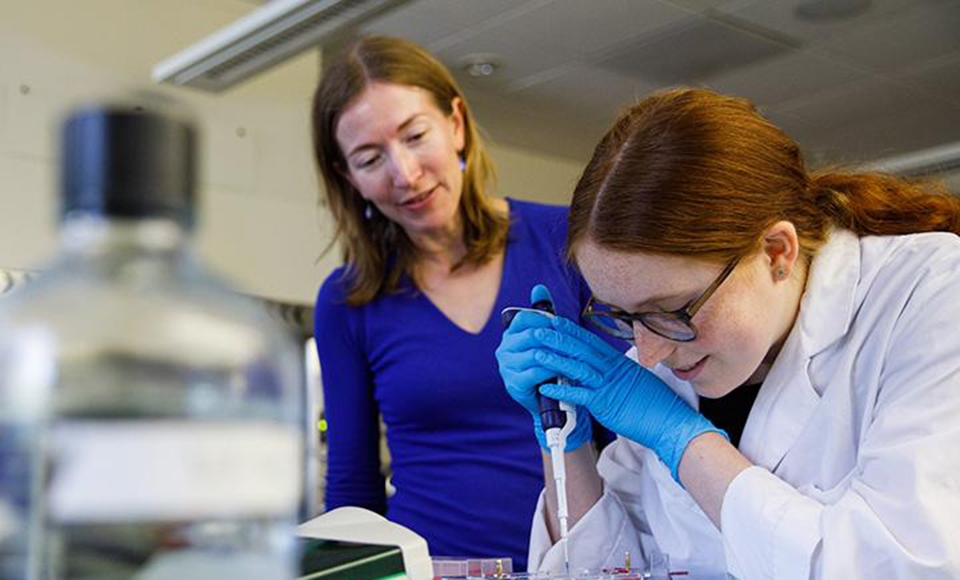
Dr. Protas in the lab with a student

7. What advice would you give to young people interested in genetics and scientific research?

Find some interesting questions and see how you can be a part of answering them.

8. Are there any projects you are working on right now?

Yes, using some genomic techniques and also looking at variation present in the surface form.

Dr. Protas' Zoom Seminar

Learn More:

- https://works.bepress.com/meredith-protas/

- https://marinscienceseminar.com/blinded-by-the-lack-of-light/

Tuesday, March 31, 2015

Interview with Dr. Katie Ferris of UC Berkeley

by Angel Zhou, Branson School

Monkey Flower 

Monkey flowers and mice - two radically different things. Yet, biologists, like Dr. Katie Ferris, are studying how native monkey flowers and mice have adapted to drastically different environments. 

Dr. Ferris currently works with Dr. Michael Nachman at UC Berkeley, using genetic sequencing and samples of monkey flowers and mice to show how organisms are often adapted to their local environment and that these adaptations are genetically based. 

To learn more about Dr. Ferris and her work with Monkey flowers and mice, read the following interview:

1) How did you decide to enter your field of work?
I decided to become a biologist pretty early on in life. When I was little I loved being outside and interacting with the natural world, especially with plants. Because of my attraction to plants I often got in trouble for picking flowers in my mother's garden. When I was three years old I picked off every single bright green new hosta lily shoot that popped out of the earth. My mother was furious that I had laid waste to her hostas. After she calmed down a little she told me that when I grew up I should be a botanist because then I could pick any plant that I wanted without getting in trouble. The notion stuck and I pursued biology throughout high school and into college. In college I got a job in a lab that studied plant evolutionary genetics and learned a lot of new and exciting things through doing my own research. That experience is how I became interested in my current field of the genetics of adaptation in wild organisms.

2) Describe your typical day at work as a geneticist. What are the best parts of your job? What are the worst parts?
My typical day at work involves several different kinds of activities, which is something I like. Typically I will attend a scientific talk on something related to my interests, do hands-on work with mice (or monkey flowers in my former job), spend an hour or two doing molecular biology in a wet lab and of course spend a little time working on my computer analyzing data or reading scientific papers. The work with animals and in the wet lab usually involved working with undergraduate students who volunteer in the lab in order to participate in research. Some of the best parts of my job are getting to work with students and trying to spread my love of biology and scientific research. I also enjoy the precious and satisfaction of laboratory work and the personalities of the mice. The worst part of my job is when I have to spend a lot of time dissecting dead mice. I did not go into medicine for a reason :)

3) How did you decide to study monkey flowers and wild mice specifically? What conclusions have you drawn thus far in your research?
I decided to study monkey flowers when I was interviewing for graduate school. I visited a lot of different labs that studied plants, but the monkey flowers were by far the most captivating. They are bright yellow, happy little things and closely related species live in an incredible range of different environments from old copper mine tailings to salty coastal sand dunes. They are just really cool plants. I became interested in wild mice because of the work my post-doc advisor had done on the genetics of mouse coloration. He found the genetic changes that caused light colored desert mice to become dark when they lived on black rock outcrops. The mice that live on the dark rocks can then blend in to their surroundings and are less likely to be eaten by predators. I like making hypotheses more than drawing conclusions, but I would say that the main conclusion I have drawn from my research so far is that organisms are often adapted to their local environment and that these adaptations are genetically based. I have also concluded that biology is very complicated 

4) What is your ultimate goal in studying the genetics of adaption and speciation?
My ultimate goal in studying the genetics of adaptation and speciation is to understand better how the world around us works. I want to understand which genes are involved in important traits and if the same genes are used repeatedly to evolve the same traits in different organisms. In short, I want to know if the genetic basis of adaptation is predictable in any way. I also just generally want to contribute new knowledge to the scientific community. A better understanding of the genetic basis of ecologically important traits like drought tolerance or coat color can also be used by scientists in applied field to help improve agriculture or medicine. 

Dr. Katie Ferris, UC Berkley

To learn more about the genes and species’ adaptation to extreme environments, join us on Wednesday, April 1st for Dr. Katie Ferris’ seminar, “From Monkey Flowers to Wild Mice: A Tale of Genes, Adaptation and Extreme Environments” in Room 207 at Terra Linda High School in San Rafael. For more information, visit Marin Science Seminar's Facebook page: https://www.facebook.com/events/850586588342167/

Wednesday, September 14, 2011

What's in Our Genes?: How our genes make us who we are"

Wednesday, September 28th, 2011
Terra Linda High School, 320 Nova Albion Way, San Rafael, CA
Room 207

RSVP on FaceBook
with Jane Gitschier, Ph.D. of UCSF's Institute of Human Genetics

What makes us male or female?  What makes us susceptible to disease?  What makes us different from each other? And what makes us different from other animals?  Come learn the answer to these questions.  It's all in our genes! Download the flyer. (September 28, 2011)
 
Dr. Gitschier’s laboratory has broad interests in the field of human genetics, ranging from past work on the molecular genetics of hemophilia, through gene discovery for a variety of inherited disorders. Combined with discovery of genes in mouse mutants and the generation of mouse models for human disease, her research has led to a deeper understanding of heavy metal metabolism and has provided more accurate genetic diagnosis and prognosis for families. Currently her lab is engaged in two unusual projects. The first concerns understanding the genetic basis for absolute pitch perception, a rare cognitive trait in which the pitch of a tone or sound can be named without any reference tone. While she hypothesizes that AP has a large genetic component, exposure to music in early childhood is also key. A second project involves the use of DNA haplotypes to infer ancestry, an endeavor known as genetic genealogy.
 
Jane Gitschier joined the UCSF Faculty in 1985 following post-doctoral work at Genentech. She received her PhD from MIT in Biology in 1981. She was an HHMI Investigator and a Guggenheim Fellow. Her longstanding interest is in human genetics. She lives with her daughter Annie Steinberg and cat Pogo in San Francisco.

Interview with Irfan Kathiriya: How to Make or Break Your Heart

By: Sahiti Namburu School: Terra Linda High School Dr. Kathiriya is a pediatric cardiac anesthesiologist and Professor of Anesthesia at t...

About Us

Marin Science Seminar is a one-hour science lecture/presentation with a question and answer period open to all interested local teenagers, educators and community. Seminar sessions are held 12 Wednesday evenings during the school year, from 7:30 to 8:30 pm in the Innovation Hub at Terra Linda High School, 320 Nova Albion Way, San Rafael. Seminar speakers are scientists, mathematicians, engineers, physicians, technologists and computer programmers. The topics presented are in a specific area of the speaker’s expertise, geared to interested high school students.