Showing posts with label robotics. Show all posts

Wednesday, October 11, 2017

"Cyborgs! The Not-so-distant Future of Human-Machine Integration" Interview with Dr. Nuria Vendrell-Llopis

By Rachael Metzger - Marin Science Seminar Intern 

Dr. Nuria Vendrell-Llopis, a Postsdoctoral Fellow at UC Berkeley's Brain-Machine Interface Systems Laboratory with a Master in Telecommunications Engineering specializing in Electronics from the Universitat Politecnica de Valencia, Spain, and a PhD in Biomedical Science, specializing in Cognitive and Molecular Neuroscience from KU Leuven, Belgium, spoke to Marin Science Seminar about her work with cyborgs.
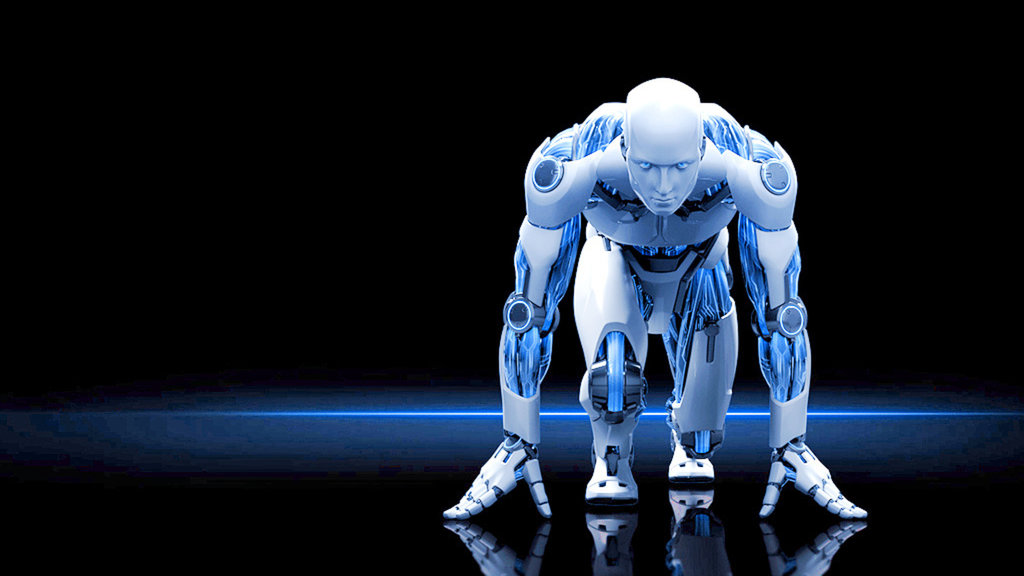
Cyborg (Source: assets4.bigthink.com)

How did you first become interested in Telecommunications Engineering and Biomedical Science?

“I was a kid when my brother got the first computer in the house and I was amazed by it. I wanted to understand how it worked. At that moment in time I thought computers were (or soon would be) way smarter than humans. With time I focused more of my attention in electronics and signal processing so I started my Telecommunications degree in college. Believe it or not, back then I hated anything that had to do with biology. Computers were the future; biology was unimportant. One day in class, a professor brought the idea that there was a limit to the miniaturization of integrated circuits, and that the future of computers could well be bio-computers or quantum computers. That shocked me, quantum computers sounded interesting, but how could something as faulty and unreliable as biologic cells be better than silicon circuits? I didn't want to believe him, so I started searching about the subject on my own, news journals at first, then more scientific journals... and I got hooked.”


Was there a specific time or person that sparked your interests?

“My parents. I know it sounds cheesy, but I see many adults annoyed by kids who are constantly asking questions. We should be fueling that curiosity, never cutting it down. My parents always answered no matter how silly the question was.”


Has studying around the world influenced your perspective on your work? If so, how?

“Not only on my work, on everything. Going to a different country, and I don't mean visiting, I mean really living among them, changes the way you see even the smallest things. You see the flaws of your countryman, but you also have a greater appreciation of their strength. I think it is an opportunity for growth that any student should take given the chance.”


What is your favorite part about your job and studies?

“About my job, I like the constant interchange of ideas. I teach to students but I also learn from them. There is always something new, a new discovery, and a new tool. It is very dynamic, tiring sometimes, but never boring. It gets better when you think that your research may be helping thousands and thousands in the future. However, what I like the most about my job and my field in particular is that we are faced with the biggest mystery of our era, like nuclear energy and space discovery were before us. The brain is the new unknown and I would love to be one of those responsible in unraveling its secrets.”


What advice do you have for young people who would like to follow in your footsteps?

“Please DO! We need young people, and young ideas. Now, my advice would be, go to college, but go to college in Europe or Australia then get your PhD back in the USA. Do internships, try working in industry, come back to academia if you like. Move around, travel the world, engage with people from different cultures. Be open to new ideas, but critic nonetheless. Learn from each small thing and the most important part, never forget to enjoy the trip.”


Monday, May 12, 2014

High Tech Mannequins

by Gillian Parker, Tamalpais HS   

Oftentimes it is nerve-wracking or even dangerous for new medical staff to carry out certain procedures on real patients. At the VA Medical Center in San Francisco, the Simulation Center has high tech mannequins to help train staff in a low-risk environment. These mannequins simulate a normal patient and allow new staff to practice various procedures like chest tube insertion and IV catheter insertion, among others. They can also be hooked up to monitors that are often used to observe patients.
     Abi Fitzgerald practices one day every week in the emergency department at the SFVA as part of her one year fellowship in advanced clinical simulation. She is an RN and achieved her MSN at San Francisco State University. Read the following interview with Abi Fitzgerald to find out more about her experience with the simulators!


1. What is the best part about having the high tech mannequins to practice on?
    
    The manikin's ability to simulate human functions allows clinicians to practice going through the physical motions assessing patients in both emergent and non-emergent situations, as opposed to verbally walking through the process.  This develops muscle memory and skills for recognizing normal vs. abnormal breath sounds, heart sounds, mental status, neurological functions and more.  

2. How would medical staff be trained without these medical robots?
    They could practice on actors, in which case the abnormal functions such as wheezes or heart murmurs are difficult to simulate.  They would also practice on real patients, which they still currently do, but using a manikin allows them more freedom to perform procedures and other tasks that they wouldn't necessarily be able to do on a live patient. Working with manikins allows students and clinicians to refine their skills before working with actual patients.
3. What procedures have you performed on the simulators? Could you describe some?
This year the VAMC sim lab acquired a few new simulators that have allowed us (the simulation fellows) and the clinicians who train on them, to become more familiar with a lot of new procedures.  We now have an endovascular trainer which simulates procedures that take place in the cath lab such as non-open heart valve replacements.  This is when the doctors access the heart valve through a long wire and tube that is inserted in the leg and follows the artery all the way up to the aorta and into the heart where they can replace replace a heart valve using fluoroscopic imaging. We also have a new manikin that simulates ultrasounds and displays a three dimensional virtual reality image on a computer screen.   
4. Are there any flaws/negatives to the simulators?
   
The cost of acquiring the simulators and the repair costs can be high, but the quality of training and knowledge gained are very much worth it.  Additionally, ongoing research projects have resulted in the acceptance of grant proposals which has made the acquisition of some of the simulators possible. 
5. What are some things that the simulators can't fully prepare you for?
  Even though we do our best to make simulated scenarios as real as possible, there are always some elements such as smells and unexpected outcomes that can be difficult but not impossible to simulate well.

Come to the Marin Science Seminar on Wednesday, May 14th, 7:30-8:30 to hear Abi Fitzgerald and Richard Fidler talk about medical education robots at Terra Linda High School in Room 207, 320 Albion Way, San Rafael, CA 94903

The Future of Medical Education: Death-Defying Robots

by Claire Watry, Terra Linda HS

This week the Marin Science Seminar introduces a unique presentation on medical education with Rich Fidler PhD MBA and Abi FitzGerald MSN RN of the VA Medical Center and their special guests - robots! These humanlike robots are utilized by medical practitioners at the Simulation Center at the VMCA in San Francisco to learn how to perform a variety of procedures and respond appropriately to different emergency scenarios. 


Rich Fidler is the Director of the Healthcare Simulation which places him in charge of all of the simulation research, education, training, and process evaluations that take place in the entire hospital, including emergency, critical care, surgery, and disaster preparedness. Fidler is also the Co-Director of the Fellowship Program in Advanced Clinical Simulation. Fidler explains this role in the following quote; "I am responsible for ensuring that our advanced fellows are receiving challenging experiences, quality didactic education in statistics, research design, thoughtful data analysis. I also ensure that they will be able to go out to conduct clinical simulations independently." In order to obtain these job titles, Fidler has collected numerous degrees and gone through extensive medical training. 


Read the interview with Rich Fidler below and be sure to attend this weeks's Marin Science Seminar. 


What degrees and training do you have, and how do they relate to each other?


PhD in Physiological Nursing from UCSF--allows me to apply knowledge and principles of physiology to understanding biomedical engineering solutions to clinical problems.
MS in Human Factors Engineering--allows me to understand human-technology interfacing, and allows me to more completely understand the reasons that people have problems operating medical equipment. 
Anesthesia Training--allows me the skill set for airway and physiologic patient monitoring and surgical perspective for a well-rounded clinical practice
Critical Care Training--allows me the experience to provide care for the sickest of hospitalized patients, applying physiology, chemistry, and pharmacology to improving patient conditions.
Primary Care Training--allows me the perspective to understand how diseases evolve over long periods of time, and also allows me to see how patients choose to participate in their healthcare
MBA--having a master's of business administration allows me the knowledge to understand people operating in a system, particularly with skills related to managing people. Frequently, it is important for me to elicit a particular behavior from our staff, but this needs to be done respectfully so that the employees WANT to do a good job.


How did you become interested in the medical field? 

I developed a special interest in healthcare when my grandfather became ill with heart problems while I was young. As early as 8 years old, I would go to spend every evening with my grandfather to try to make him feel better by pushing the fluid out of his legs. From there, I got more interested in why his heart was failing and how I could make it better. I got more interested in cardiac resuscitation after my grandfather had a sudden cardiac death event and we saved him. Then my own father had a series of 3 cardiac arrests which he survived from high quality CPR and early defibrillation, but he eventually died with the fourth cardiac arrest. 


How did you become involved in the Simulation Center?

I have always liked teaching, and I think that learning with your hands is better than someone talking you to death. When I told my father about what I did with simulation, he said, " You can't make a living playing with dolls." I guess I showed that you should do what you like to do, even if your parents don't think it's worthwhile. You have to make yourself, not your parents, happy with your career. The harder stunt is to figure out how to make lots of money doing what you love!

Example of a Simulation Center

What projects have you worked or are you currently working on in the Simulation Center?

Defibrillators.
Resuscitation.
Heart monitors.
Disaster evacuation from the hospital in the middle of surgery.
Should we unwire a jaw wired closed or do a cricothyrotomy to get oxygen to the patient?
What is the best way to open a chest for bleeding in the immediate post-open heart period?


What is the most rewarding part of your job?

Seeing people that did not know how to do something not only learn how to do it, but also gain a certain amount of confidence and mastery doing the new task. 


What advice do you have for young people aspiring to have a career in the medical field? 

Do it! My grandfather said that I should either be an obstetrician or an undertaker, that way you can get people either coming or going! If you aspire to go into the healthcare field, explore your options. Becoming a physician or nurse is not your only option to make a meaningful contribution to healthcare. Medical research, especially with the human genome, is really exciting. If I were growing up now, I would probably be fascinated with that. Also, the roles of pharmacists and therapists are frequently overlooked as vital members of the healthcare team. The money should NOT be a factor in your decision. No job is worth getting up every day if you hate going. I love going to my job every single day.


Check out this very exciting presentation "Death-Defying Robots in Medical Education" with Rich Fidler PhD MBA and Abi FitzGerald MSN RN of the VA Medical Center on Wednesday, May 14 7:30 – 8:30 pm, Terra Linda High School, San Rafael, Room 207. 

Read an excellent article about Rich Fidler here 

~Claire Watry

Links:
http://scienceofcaring.ucsf.edu/acute-and-transitional-care/improving-cardiac-care-science-human-use
http://www.ucsf.edu/news/2011/01/8397/new-teaching-and-learning-center-transform-health-education-ucsf
https://www.youtube.com/watch?v=cZNa0vmdgSI


Interview with Irfan Kathiriya: How to Make or Break Your Heart

By: Sahiti Namburu School: Terra Linda High School Dr. Kathiriya is a pediatric cardiac anesthesiologist and Professor of Anesthesia at t...

About Us

Marin Science Seminar is a one-hour science lecture/presentation with a question and answer period open to all interested local teenagers, educators and community. Seminar sessions are held 12 Wednesday evenings during the school year, from 7:30 to 8:30 pm in the Innovation Hub at Terra Linda High School, 320 Nova Albion Way, San Rafael. Seminar speakers are scientists, mathematicians, engineers, physicians, technologists and computer programmers. The topics presented are in a specific area of the speaker’s expertise, geared to interested high school students.