Showing posts with label marine mammals. Show all posts

Friday, September 30, 2022

How the Survival of Elephant Seals is Helping Scientists Research Climate Change

by Samantha Dvorin, Archie Williams High School 
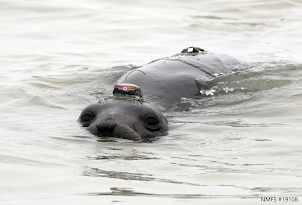
Female elephant seal recording data
(Costa, 2022) 
  

 One marine animal is making a big splash in the scientific community for its assistance in tracking ocean temperature fluctuations using tagged sensors, population data, and migration patterns. The mysterious elephant seals were once some of the most hunted ocean creatures, almost to the point of extinction in the nineteenth century. Their thick layer of blubber was exploited by whalers and hunters and used as an oil source. These animals have made a huge comeback thanks to conservation efforts, awareness, and legal protection, especially in Antarctica and California.

   There are two species of these earless marine mammals, the Northern elephant seal (Mirounga angustirostris) and the Southern elephant seal (Mirounga leonina). The Northern elephant seal is native to California, Baja California, Mexico, and other nearby offshore islands while the Southern elephant seal can be found in sub-Antarctic and Antarctic waters (Moritsch & Lee, 2021). Most elephant seals spend their time breeding on land but living in colder water. Breeding season is an especially intense time for these animals as males fight for dominance and battle to collect a large group of female elephant seals. After the breeding season, they make their way to the water and spend their time migrating in search of food. They spend months at sea searching and diving deep for fish, squid, and similar marine creatures (U.S. National Park Service, 2021).

    Despite defying the odds and repopulating, elephant seals are still left to face the consequences of climate change. As the burning of fossil fuels like coal, oil, and gas continues, marine animals are some of the most affected because they rely on the oceans for their habitat and food. Sea ice provides both a home for aquatic creatures like polar bears, penguins, and seals, but it also affects the temperature of the oceans. Many organisms are being forced to migrate due to warming water; some even have to change their feeding and breeding patterns to acclimate to their new normal. These prolonged water warming events are becoming more common and are referred to as Marine heat waves. The most prolific in recent history is the North Pacific Blob which stretched from 2013 until 2016. It was the longest-lasting and most extensive marine heat wave recorded which caused many elephant seals to migrate toward colder water where they can find better prey. But scientists are using elephant seals to inform the world of the extent of damage done by these heat waves both on the surface and deeper (Wong, 2022).
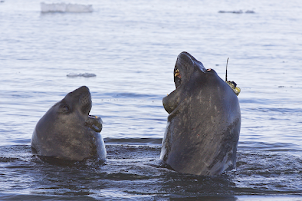
Southern elephant seals with sensors (McMahon, 2016)
    Biologists and ocean scientists at UC Santa Cruz did a study collecting ocean data using tags placed on Northern elephant seals. The seals record depth, temperature, and salinity data that would be otherwise extremely difficult for the researchers to obtain. The seal data collected during the Blob revealed that this ocean-warming event extended deeper into the ocean than once believed, as deep as 1,000 meters below the surface. Marine heatwaves are likely to occur more frequently and severely as temperatures continue to rise worldwide. Understanding these heat waves like the “Blob” will allow scientists to predict their severity, development, and more (Hosler et al., 2022).

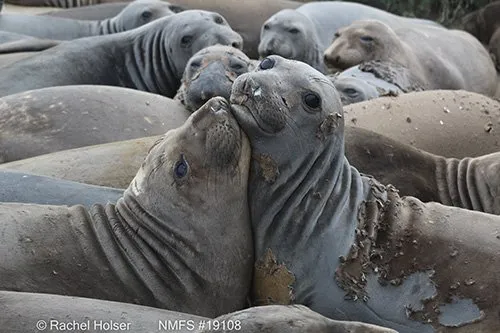
Northern Elephant Seals at Año Nuevo Reserve (Hosler, 2022)
Northern elephant seals are not the only species being used to understand our Earth’s changing climate. In Antarctica, Southern elephant seals are helping scientists track the influence of climate change using sensor-tracking devices similar to the UC Santa Cruz study. Data from the deep diving seals shows that melting ice sheets are disrupting the worldwide food system as the oceans become less salty. This lack of salt is likely affecting the global ocean conveyor belt that transfers heat across the Earth’s seas (McSweeny, 2016). The seals allow scientists to obtain a large range of data patterns as they follow their diverse migration practices. Although once on the brink of extinction, elephant seal populations have bounced back and are now major contributors in allowing scientists to better understand the impacts of climate change on the ocean and marine mammals. 

On September 21, 2022, Ph.D. student Alison Payne presented “Cutting Edge Research on Elephant Seals at Año Nuevo Reserve” at the Marin Science Seminar where she discussed the natural history of elephant seals and the long-term monitoring program at Año Nuevo. Learn more about Alison and her work here.

Works Cited

Herraiz, L. (2016, August 23). Seals help scientists get to the bottom of Antarctic changes. Carbon Brief. Retrieved December, 2022, from https://www.carbonbrief.org/seals-help-scientists-get-to-the-bottom-of-antarctic-changes/

Hosler, R. R., Keates, T. R., Costa, D. P., & Edward, C. A. (2022, July 4). Extent and Magnitude of Subsurface Anomalies During the Northeast Pacific Blob as Measured by Animal-Borne Sensors. AGU Online Library. Retrieved December, 2022, from https://agupubs.onlinelibrary.wiley.com/doi/full/10.1029/2021JC018356

Moritsch, M., & Lee, C. J. (2021). Elephant Seals. National Geographic. Retrieved December, 2022, from https://www.nationalgeographic.com/animals/mammals/facts/elephant-seals

U.S. National Park Service. (2021, May 21). Northern Elephant Seal. National Park Service. Retrieved December, 2022, from https://www.nps.gov/places/northern-elephant-seal.htm

Wong, K. (2022, August 4). Elephant Seals Measure "the Blob" - Natural Reserve System. UC Natural Reserve System. Retrieved December, 2022, from https://ucnrs.org/elephant-seals-measure-the-blob/

Yale Environment 360. (2016, August 24). How Elephant Seals Are Helping Scientists Study Climate Change. Yale E360. Retrieved December, 2022, from https://e360.yale.edu/digest/how_elephant_seals_are_helping_scientists_study_climate_change


Monday, January 30, 2017

The Intelligent Sea Lion


The Intelligent Sea Lion
By Shoshana Harlem, Terra Linda High School


The brain of a sea lion!
Can an animal still be a good scientist without thumbs? The answer is yes, because the sea lion is in this exact situation. Although sea lions have no thumbs, they have a big brain. Their brain is about the same size as a chimpanzee brain. They are one of the few mammals besides dolphins, humans, elephants, and whales that have brains that weigh more than 1.51Lbs. Scientists are not sure why the sea lion has such a big brain, but they think that it might be because they have a large body size and those two usually correspond. Other theories have to do with the weightlessness of the marine environment, coping with cold water temperature, or perhaps it is just a random outcome of evolution.
The sea lion’s brain consists of different regions for processing information from their whiskers. A specific, corresponding, area in the brainstem is devoted to each whisker on the sea lion’s nose. The areas in their brain that are responsible for processing touch information from the whiskers and the skin are the thalamus, cortex, and brainstem. Likewise, the human brain has specific areas which correspond to the individual fingers of a person. The whiskers on the sea lion assist with sea lion behavior and sensation. There are certain areas in the sea lion’s brain which are made for processing touch sensations from their flappers and tail. Scientists don’t know a lot about the sea lions cerebral skills. The sea lion has a particular part of their brain called the Bischoff’s Nucleus, which is very well-developed. It is surprising that sea lions have this part of their brain because it is usually found in animals with prominent tails such as kangaroos, raccoons, and whales. But the sea lion’s tail is tucked and small behind its hind flippers.
A sea lion's very important whiskers!
On each side of a sea lion’s face, are 38 whiskers. The whiskers can grow to be eight inches in length and are really sensitive. The sea lion produces more nerve fibers than any other animal in the animal kingdom. Its whiskers can be helpful in many ways too. One way is that they use their whiskers is to spot a fish by looking for changes in the flow of the water. They can find fish that are swimming up to 590 feet away from them. The whiskers can also help a sea lion know the differences between shapes and sizes up to as far as a fraction of a centimeter.
Amazingly, the sea lion’s brain is capable of higher cognitive functioning. A sea lion can play a game of Concentration. Through trial and error, they can match unrelated symbol pairs. They can also recognize signals, which is really useful in the wild. In this way they can find food, and know if someone is their friend or their enemy. Sea lions also have the ability to think logically. The can know that if a=b and b=c, then a=c.
To learn more about why sea lions are such good scientists, come to the Marin Science Seminar at Terra Linda High School in room 207 on Wednesday, February 8, 2017. Claire Simeone DVM of the Marine Mammal Center in Sausalito will be speaking. Join us and learn!


Sources:


Wednesday, October 8, 2014

Saving Our Ocean Friends: An Interview with Dr. Claire Simeone of the Marine Mammal Center

by MSS Intern Isobel Wright, Tamalpais High School

From sea lions with cancer to stranded motherless seal pups, Dr. Claire Simeone knows just what to do. Dr. Simeone works as a Conservation Medicine Veterinarian at The Marine Mammal Center in Sausalito, California and at the National Marine Fisheries Service in Washington, DC. In addition to tending to sick animals, she travels the world to attend Unusual Mortality Events, international training programs, and works on the Marine Mammal Health Map. Dr. Simeone attended the University of Maryland College Park to receive her BSc in Physiology and Neurobiology, and graduated from veterinary school at Virginia Tech. Read the following interview to learn more about life at the Marine Mammal Center and working with animals. 

Claire Simeone, DVM

            Could you walk me through your typical day at The Marine Mammal Center?

One of the best things about working at The Marine Mammal Center is that every day is different. Some days, you’re caring for harbor seal pups that have been separated from their mother. Another day, you’re treating California sea lions with cancer. You might be medicating elephant seals that are dying of lungworms. Some days, you’re treating all of those animals, plus caring for the two hundred additional animals that are ALSO onsite. 

As a veterinarian, I usually start my day walking around the pens to check in on all of the animals on-site, and then our team starts procedures, which include blood draws, x-rays, and surgeries. If animals die, we perform post-mortem exams to determine why they died. At the same time, our volunteer crews (more than 1,000 committed people!) are preparing fish, feeding the animals, and cleaning their pens. Our night volunteer crews take care of the animals into the night, and the veterinarians and technicians are on-call 24 hours a day to make sure all of the animals receive the care they need.

What are the best and worst parts of your job?

There are so many best parts of my job. First, I’m lucky to be able to travel around the world to care for marine mammals and learn more about them. Second, I really feel that I’m making a difference with the work I’m doing – whether it’s saving a seal pup or training the next generation of marine mammal veterinarians. Third, I’m constantly learning new things – about marine mammals, their habitats, and what affects their health. 

Because I do work with animals, a difficult part of the job can be seeing animals that are suffering, often because of things humans do – but it helps to know that we are doing everything we can to bring that animal back to health.

What does it feel like to rescue an animal?

Imagine getting a call from someone who was on vacation, and saw a California sea lion that had fishing line around his neck. First, you feel focused – you take down the description of the animal from the citizen, check your maps, and plan out your strategy. Your rescue volunteers have confirmed that this animal is one you’ve been watching for months, and he’s asleep on the beach. You load up the truck, and make the drive to meet your team. You feel hopeful – he’s still snoring away. Holding your breath, you sneak up slowly, and then with a leap you throw the net over his head. He roars as he jumps up and finds himself trapped. With swift action your team boards him into a carrier, and as stealthily as you came, you load him into the truck. You feel elated as you watch him resting calmly on the way home. 

After a quick procedure to remove the line, it’s clear his wound will heal on its own, and he’s ready to go back to the ocean. After driving him back to the beach, you open the carrier, and he strides out into the waves and dives under the break. You feel proud that you’ve saved this animal’s life, and returned him to his ocean home. 

What’s the most common injury/disease you see in marine mammals? How can we prevent this?

Unfortunately, we commonly see injuries that are due to something called human interaction – entangled in fishing line, nets, or plastic packing straps; ingesting pieces of plastic; struck by a boat; or gunshot. In 1972 the Marine Mammal Protection Act was passed, making it illegal to harass or harm a marine mammal. However, many marine mammals are still harmed in passive ways from our trash or discarded items. You can prevent these entanglements by properly disposing of plastics, and helping to keep beaches clean by picking up any trash you see. Just a few weeks ago the annual International Coastal Cleanup Day brought 54,000 volunteers to California’s coasts. They removed over 680,000 pounds of trash in one day!

What level of education and experience do you need to obtain a job like yours?

As a veterinarian, I have a bachelor’s degree, as well as a DVM – Doctor of Veterinary Medicine. However, there are many ways that you can be involved with marine mammals or ocean conservation – through a Master’s or PhD, if you’re more science-focused, or you can have a completely unrelated career, and get your fill through volunteering at a facility like TMMC. We even have a Youth Crew volunteer program for teenagers 15-18 years old (learn more at http://www.marinemammalcenter.org/Get-Involved/volunteer/youth-crew ). As far as experiences go, I would recommend doing as much as you can to get a variety of experiences, which will help you decide what is really right for you. I’ve worked with dogs and cats, horses and cattle, birds and seals, and each experience set me up for the next step in my career. 

What have you learned from working with these animals?

I’ve learned that in order to conserve energy while diving, some seals can lower their heart rate to 10 beats per minute, and right before they surface, their body speeds the rate back up to 120. I’ve learned that a sea otter, if left alone, will unscrew all of the screws on a drain – that were placed with an electric drill! – with its bare paws. And I’ve learned that a harbor seal, blind from cataracts, can find fish by sensing the water movement with its vibrissae (whiskers). Each one of our patients has given me great stories with which to share the knowledge I’ve learned. 

What is an Unusual Mortality Event? What is it like to attend one? Tell me about the most recent one you attended? 

If a group of marine mammals are sick, they may strand on the beach near one another. Unusual Mortality Events (UMEs) are declared when the number of sick or dying animals is larger than expected in that area or time frame. A panel of experts is then called to lead a response to care for the animals, and to try to figure out why they are dying. A recent UME was close to home – in 2013, more than 1500 starving California sea lion pups washed up on southern California beaches. Thanks to the UME response team, it was determined that the reason the pups were starving was because the fish their moms were feeding on had moved farther offshore – meaning they had to go farther to forage. This caused moms to either lack the milk they needed to nurse them, or abandon their pups completely. Caring for hundreds of sea lion pups at a time is exhausting – most need to eat 3-4 times a day, and they may need treatment for vomiting, diarrhea, or pneumonia. It was thanks to hard-working rehabilitation centers, like TMMC, all along the California coast, that we were able to save so many pups. 

What is the Marine Mammal Health Map? How do you contribute to it?

Think about all of the animals we’ve talked about – starving sea lions, entangled elephant seals, gunshot animals or animals with cancer. Each one of these animals provides a unique look at what is happening in the ocean at that location. All of the animals that come through TMMC have a record with all of their health information. Similarly, all of the stranding centers across the country have records on all of their animals. However, there is no centralized database to collect these data, or display them for all to see. The Marine Mammal Health Map will be that space – so that biologists, veterinarians, and members of the public will know what’s happening to marine mammals in their area. I’m working with scientists from around the country to develop the Health Map and ensure that all of our marine mammals are represented. You’ll have to come to the talk to learn more!

Watch this video below to see the process of the rescuing, rehabilitation and release of a sea lion...


Join us for "Sick Seals and Seizing Sea Lions: What Marine Mammals Can Tell Us About the Health of Our Oceans" with Claire Simeone DVM of The Marine Mammal Center, Sausalito - Wednesday, October 8th, 2014 at Marin Science Seminar

Interview with Irfan Kathiriya: How to Make or Break Your Heart

By: Sahiti Namburu School: Terra Linda High School Dr. Kathiriya is a pediatric cardiac anesthesiologist and Professor of Anesthesia at t...

About Us

Marin Science Seminar is a one-hour science lecture/presentation with a question and answer period open to all interested local teenagers, educators and community. Seminar sessions are held 12 Wednesday evenings during the school year, from 7:30 to 8:30 pm in the Innovation Hub at Terra Linda High School, 320 Nova Albion Way, San Rafael. Seminar speakers are scientists, mathematicians, engineers, physicians, technologists and computer programmers. The topics presented are in a specific area of the speaker’s expertise, geared to interested high school students.