Showing posts with label astrophysics. Show all posts

Wednesday, November 13, 2019

"Star Clusters: Many-Body Gravitational Laboratories" - An Interview with Nicholas Rui of UC Berkeley

By Shoshana Harlem (MSS Intern, Terra Linda High School)

Nicholas Rui
Nicholas Rui is a current fourth-year undergraduate student at UC Berkeley who is studying physics and astrophysics.


1.  What made you interested in studying star clusters?

I was always somewhat interested in astrophysics as a child, as it seemed fantastical to me that humans would be able to gain so much intuition about the cosmos from our humble vantage point of Earth. My first research project ever, in fact, was on a dissolving star cluster near the center of the galaxy called the Quintuplet cluster, and at that time I was introduced to the fascinating dynamics that govern astrophysical objects such as these.

2. What are some interesting facts about star clusters that you have learned from studying them?

When we take our first classes in physics, one of the first things we learn is Newton's Universal Law of Gravitation, which describes a straightforward attractive force between any two objects with mass. Even though the law, at first, sounds superficial (and a bit boring), it turns out that there are some strange consequences of gravity which appear when you have millions of objects all interacting under gravity. For example, when you add energy to a normal material, you cause the atoms within it to jiggle around faster (thus raising its temperature). However, in gravitationally bound systems like star clusters, adding energy actually causes the stars in the cluster to slow down—star clusters have negative heat capacity. This causes star clusters to undergo runaway "core collapses" during which the number of stars in the cluster core rockets up, producing a dense region where stars interact very often.

3. What are the best parts of your job? What are the hardest parts of your job?

The best parts of my job are where, after a very long period of work, my code finally outputs that coveted plot outlining the answer to the question that I was asking, and being able to weave it into a coherent physical picture. The hardest parts are, of course, some of the moments in between where I am wrestling with some code bug, or when I am struggling to word a sentence in a precise enough way to communicate some physical phenomenon without going too deep into the weeds. You learn to take the good with the bad, but I promise the good is worth it.

4. What advice would you give to people who want to study star clusters?

Perhaps the most important thing for people who know they want to do astronomy is to learn how to code. When people think about what astronomers do, they often imagine rough-and-ready eccentrics pointing their backyard telescopes at Saturn, and it's true that some of us do this some of the time. However, especially in the age of big data, one of the primary jobs of the astrophysicist is making sense of the data that we obtain, and this requires being able to deal with it efficiently and with insight. Also, never give up your curiosity.

5. What current projects are you working on?

5. My most recent project has been on matching real star clusters that we actually observe to simulated star clusters based off of the brightness of the star clusters, as well as the velocities of those in the star cluster. Even though we can't see things like black holes, provided we trust our models, we can figure out how many black holes we expect to be inside a star cluster based off of things that we can measure.

Want to learn more about Nicholas Rui and star clusters? Join us on Wednesday, November 13, 2019 at Terra Linda High School from 7:30 PM - 8:30 PM in Room 207!

Learn more at 


Sunday, March 8, 2015

Expanding Horizon: How Black Holes Grow

By Talya Klinger, Homeschooler

Contrary to popular opinion, black holes do not exist solely to swallow up your socks, keys, and the last scoop of Rocky Road you were saving for a late night snack. Rather, a black hole is an object with such a large mass in such a small volume that nothing, not even light, can escape its gravitational pull. The black hole’s gravitational pull absorbs whatever is in its reach.

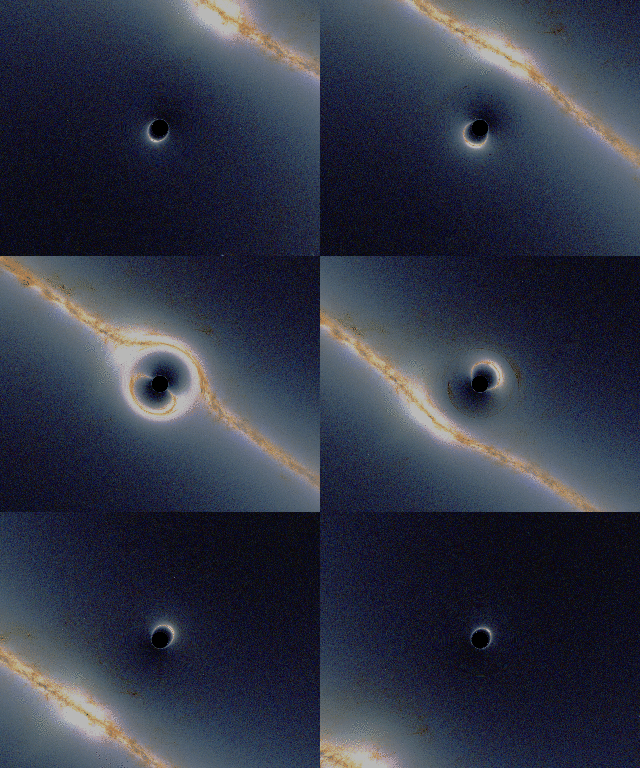
The outer limit of a black hole is an imaginary surface called its event horizon, where the black hole's gravitational pull is just strong enough that not a single photon can escape, creating a large dark space. According to Einstein's theory of general relativity, even light rays that pass by the event horizon are bent and distorted by the black hole's gravity in a process called gravitational lensing. 

This simulation of a spinning supermassive black hole from the movie Interstellar is approximately what a black hole would look like, according to general relativity.


As black holes absorb more and more objects, their mass grows. Not all black holes grow to a similar size, however. Depending on their mass, black holes generally fall into two radically different size categories: stellar mass and supermassive. Most stellar mass black holes, which are 10 to 24 times the size of the sun, are isolated and difficult to detect. Supermassive black holes, on the other hand, are millions or billions of times the size of the sun and are found at the center of most large galaxies, such as the Milky Way. Even when supermassive black holes are not absorbing matter, scientists can observe the effects such black holes have on the stars and gases around them. While stellar mass black holes are more difficult to detect unless they are in the process of absorbing matter, scientists know more about how they form than they do about the formation of supermassive black holes.

 
A simulation of gravitational lensing around a black hole and a galaxy

Many of the properties of black holes are well documented, yet the formation and growth of supermassive black holes are on the cutting edge of astrophysics. Black holes usually form out of supernovas – the explosions at the end of a star's lifespan. In young or middle-aged stars, the energy created by nuclear fusion counteracts gravity, and keeps a star from collapsing into a black hole. When a massive star reaches the end of its lifespan (when it has burned all the fuel inside of it), it explodes in a phenomenon known as a supernova. Because fusion cannot occur in the remnants of a supernova, when there is not enough energy for the supernova to counteract gravity, there is nothing to prevent the remaining matter from collapsing into a dense object, such as a black hole. By astronomical standards, only supermassive stars have enough matter to become black holes, so small stars, including our sun, merely compact into white dwarfs or neutron stars. (Spoiler alert: the sun will eventually become a white dwarf, so there is no danger of it becoming a black hole.) Scientists know more about the creation of stellar-mass black holes than about the creation of supermassive black holes, but there is a possibility that stellar-mass black holes can grow to a supermassive size by rapidly consuming the matter around them.

Once a black hole forms, it can continue to grow by absorbing more and more matter. The following is theoretical. For example, in binary star systems containing two large stars, the first star to become a black hole will absorb matter from its companion star until the younger star vanishes. When black holes are too far from stars to absorb their matter, they consume the dust and gas floating around them. When two black holes collide, it has been hypothesized that they merge together to become an even larger black hole, producing a whopping amount of energy and sending ripples known as gravitational waves through the universe. 
 A stellar-mass black hole in a binary star system

So far, the only observations of gravitational waves have been contradicted by other, more detailed observations. However, as pairs of supermassive black holes at the centers of distant galaxies spiral closer and closer to each other, the chances are good that we will eventually be able to observe and study such dramatic black hole growth.

In the upcoming Marin Science Seminar, "Snacking, Gorging, and Cannibalizing: The Feeding Habits of Black Holes," astrophysicist Steve Croft, Ph.D. will discuss how innovative telescope technologies make it possible to observe the growth of black holes in a new way, and perhaps, track disappearances from laundry baskets, tables, and refrigerators once and for all

For more information, come to the next Marin Science Seminar at Terra Linda High School from 7:30-8:30 p.m. on March 11th, 2015.

Sources:
Image Credits:

Interview with Irfan Kathiriya: How to Make or Break Your Heart

By: Sahiti Namburu School: Terra Linda High School Dr. Kathiriya is a pediatric cardiac anesthesiologist and Professor of Anesthesia at t...

About Us

Marin Science Seminar is a one-hour science lecture/presentation with a question and answer period open to all interested local teenagers, educators and community. Seminar sessions are held 12 Wednesday evenings during the school year, from 7:30 to 8:30 pm in the Innovation Hub at Terra Linda High School, 320 Nova Albion Way, San Rafael. Seminar speakers are scientists, mathematicians, engineers, physicians, technologists and computer programmers. The topics presented are in a specific area of the speaker’s expertise, geared to interested high school students.