
Nola Palestrant, Tamalpais High School
Artificial Intelligence (A.I.) is a branch of computer science that was created in the 1950s. Unlike previous computer programs, A.I. allows machines to think and behave like humans without being explicitly programmed on their courses of action. A.I. strives to mimic humans’ reasoning, intelligence, decision-making, learning, and perception abilities. There are many complex techniques being used in A.I., including Neural Networks, Machine Learning, and Deep Learning. A.I. has been the subject of many controversies for its security with personal information, fairness, and misinformation, and has been vilified in numerous books and films. Regardless, Artificial Intelligence is becoming increasingly common in our modern world. Here are some ways we interact with it in our daily lives.
Music Recommendations
So many of us listen to music daily, and platforms like Spotify and Apple Music allow us to play the songs of our choosing at any moment. These services are so popular that they generate billions of dollars in revenue every year. The platforms couldn’t be the successful programs that they are without the use of Artificial Intelligence (A.I.).
Music platforms use A.I. for a variety of functions. A.I. provides personalized recommendations based on content the user frequently listens to. It’ll suggest what it predicts you’ll enjoy and avoid what you’ll dislike. Through reinforcement learning – which involves rewarding or punishing certain behaviors – these services will curate songs that are a good fit for you. Along the same lines, platforms will use A.I. to generate specific playlists based on your taste.
Music platforms use Natural Language Processing (which helps computers to understand text) and Deep Learning (a way of processing data similar to the human brain to link messages that are not explicitly stated) to enhance search capabilities. When you search for a song, you don’t need to write the title entirely correctly for the program to answer with what you want. A.I. will establish connections between the words you write and the content you intend to see.
As A.I. continues to grow, it will further transform the music industry. Currently, A.I. is revolutionizing production, breaking apart components of songs, and telling musicians which music will most satisfy their fans. As A.I. progresses, songs will be created entirely by A.I., underscoring the need and importance of musicians.
Virtual Assistants
Siri, Alexa, and Google Assistant were some of the first Artificial Intelligence (A.I.) to noticeably make its way into our homes. Released in 2011, 2014, and 2016, respectively, these devices revolutionized our interactions with technology.
The internet is no longer just at the tip of our fingers - it's at the tip of our tongues. With only a few words, users can know the weather next Tuesday, the directions to their favorite restaurant, or the complex workings of organic chemistry. Virtual Assistants allow tasks to be completed or questions to be answered hand-free and with ease.
Virtual Assistants like Siri, Alexa, and Google Assistant utilize a variety of algorithms to transform our words into data and then respond to its commands. This procedure, known as Natural Language Processing, or NLP, enables computers to understand words or text, thereby allowing conversation between technology and humans. Other programs such as Pattern Matching Algorithm (a sub-part of NLP) and Natural Language Generation (allows the A.I. 's response to be comprehensible and thorough) are examples of Artificial Intelligence techniques in these Virtual Assistants.
In combination with A.I., these technologies can evolve into more efficient and dependable machines, with the potential of further advancement. The algorithms Virtual Assistants run on are constantly advancing, and as the data used to run these programs is trained even further, its capabilities will continue to improve. In addition, recent A.I. like ChatGPT could be integrated with older ones, creating increasingly powerful Virtual Assistants.
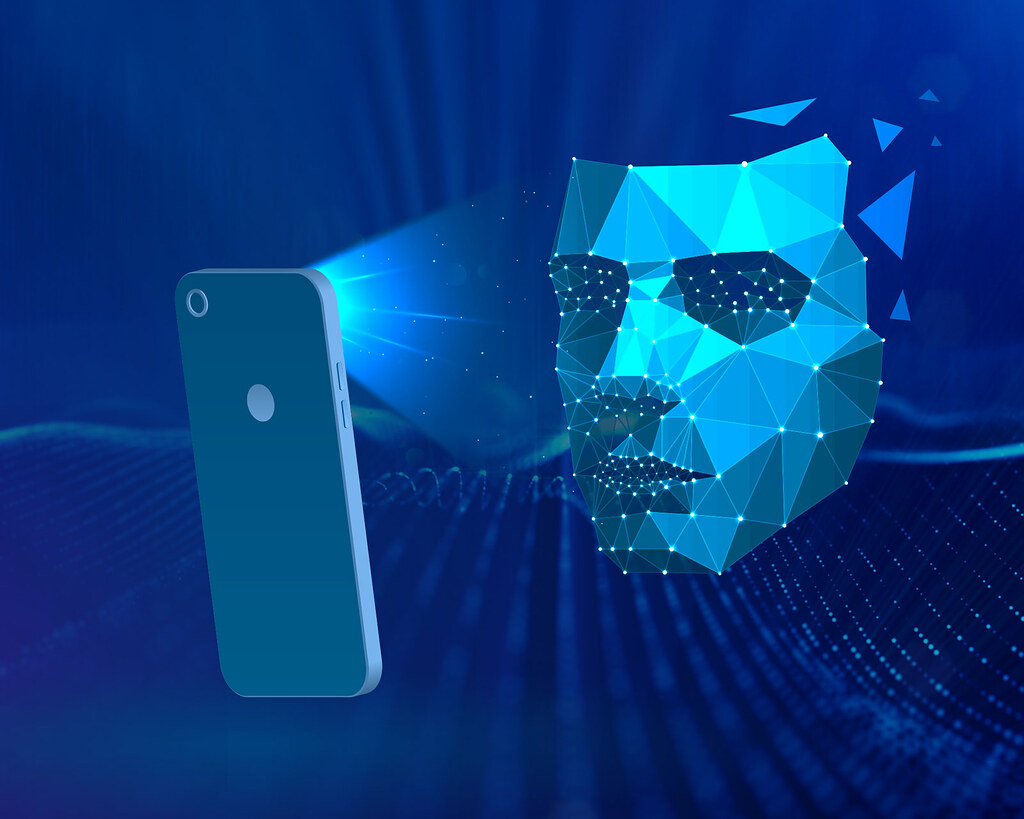 |
| Facial Recognition on personal devices |
Facial Recognition
Facial recognition, most commonly known for its use on phones, is an A.I. based technology that allows a person to be recognized despite never being seen in those same clothes, that same hair, or that same lighting. We use facial recognition (also called Face ID) to unlock our phones or purchase apps, but it can be used for anything pertaining to identity verification. Although we don't think much of it, facial recognition is a complex process.
The computer analyzes faces using their visual geometry, which is the relationship between different facial features. A.I. compares the data gathered from the original image to all the faces in the picture, finding the one that is a match. Deep learning processes enable faces to be transformed into numerical expressions. They are then used to look for similarities between the known person and the expressions of every other face.
In addition, A.I. is used in facial recognition to separate the subject from the landscape and objects in the background. Facial recognition can also be used in broader ways, such as in searching for lost people and finding criminals.
Currently, facial recognition is being developed to recognize when a person is lying. It does this by discerning subtle changes in facial expressions. As facial recognition becomes more precise and widely used, it can help prevent hacking personal items, as the only way to access the material is by being physically recognized as the owner. Facial recognition could be used to detect tiredness and other problems that may affect driving abilities, thereby reducing injuries.
Navigation
Navigation apps have become a critical part of modern transportation. Whenever we go to a new place, we no longer pull out a paper map; instead, our phones or cars direct us.
Immediately upon setting the destination, we are told of the traffic conditions, when we will arrive, and how long the journey will take us. And if you take a wrong turn - don’t worry! - the map will adjust your route automatically.
Artificial Intelligence (A.I.) is instrumental in making these features available. Using data from specific areas in the past few weeks, the map will analyze the likelihood and severity of traffic, giving the user an accurate ETA. In cases when traffic is high, A.I. suggests alternate routes to get you to your destination faster.
A.I. also takes into consideration road conditions, speed limits, and stop signs or lights. This allows it to decide the fastest route, not simply the shortest. It can also adjust to changes like road closures, crashes, or adverse weather.
This A.I. works using Graph Neural Networks, a program that can model changing data from the real world by translating it into graphs, and predict what will happen next time. It gathers this data through satellite imagery, crowdsourcing, user location data, and partnering with other companies.
In the future, A.I. could further analyze traffic data for common areas of traffic and accidents. This would enable navigation apps to route the user around such incidents before they occur. A.I. could also merge with satellites, combining data from things such as weather conditions and establishing routes more efficiently.
,_Point_Lobos_Avenue,_Autonomes_Auto_--_2022_--_112909%20(1).jpg) |
| Waymo, a Self-Driving Car Company, drives in San Fransisco |
Self-Driving Cars
Partially self-driving cars have risen to prominence over the last couple of decades, with the promises of reducing crashes by eliminating human error and expanding the accessibility of transportation. They “sense” their surrounding environment, aiming to adapt to and overcome any challenges, in order to control cars in the same way as humans.
The unpredictable and varying nature of human driving has inspired the development of self-driving cars, which rely on Artificial Intelligence (A.I.) to travel safely. Predictive modeling is the ability of A.I. to analyze patterns and anticipate future events. Predictive Modeling enables the car to anticipate the behavior of other cars and adjust to problems as they may arise. They use A.I. to make decisions in the moment, aiming to react to changes in their environment appropriately.
With the help of sensors feeding data to the computer, A.I. can recreate the car's surroundings. This allows it to recognize objects like crosswalks and traffic lights, and heed such signs correctly.
Many vehicles on the road today are already partially autonomous. Features including emergency braking and lane assistance are already widespread, with A.I. as an integral part of their success. These features have helped to keep drivers safe, and they will continue to improve.
Although completely self-driving cars are not yet commonly owned, if you live in a big city like San Francisco or Phoenix, you’re likely to see them being tested on the streets. Self-driving cars aren’t popular at the moment, but they could become much more common in the upcoming years, as products currently being tested are brought to market.
Works Cited
Artificial Intelligence (AI): What it is and why it matters. SAS. (n.d.). https://www.sas.com/en_us/insights/analytics/what-is-artificial-intelligence.html#:~:text=Artificial%20intelligence%20(AI)%20makes%20it,learning%20and%20natural%20language%20processing.
Dicker, R. (2021, May 18). A smoother ride and a more detailed map thanks to ai. Google. https://blog.google/products/maps/google-maps-101-ai-power-new-features-io-2021/
Frąckiewicz, M. (2023, March 10). The future of satellite navigation with AI and machine learning. TS2 SPACE. https://ts2.space/en/the-future-of-satellite-navigation-with-ai-and-machine-learning/
Kaput, M. (2022, September 19). How Spotify uses artificial intelligence-and what you can learn from it. Marketing AI Institute. https://www.marketingaiinstitute.com/blog/spotify-artificial-intelligence
Lau, J. (2020, September 3). Google maps 101: How ai helps predict traffic and determine routes. Google. https://blog.google/products/maps/google-maps-101-how-ai-helps-predict-traffic-and-determine-routes/
Lewis, J. A., & Crumpler, W. (n.d.). How does facial recognition work?. CSIS. https://www.csis.org/analysis/how-does-facial-recognition-work
A match made in transportation heaven: Ai and self-driving cars. Dataconomy. (2023, October 27). https://dataconomy.com/2022/12/28/artificial-intelligence-and-self-driving/
Self-driving cars explained. Union of Concerned Scientists. (n.d.). https://www.ucsusa.org/resources/self-driving-cars-101
What is natural language processing?. IBM. (n.d.). https://www.ibm.com/topics/natural-language-processing#:~:text=the%20next%20step-,What%20is%20natural%20language%20processing%3F,same%20way%20human%20beings%20can
Images:
File:San Francisco (CA, USA), point Lobos Avenue, autonomes auto ... (n.d.). https://commons.wikimedia.org/wiki/File:San_Francisco_%28CA%2C_USA%29%2C_Point_Lobos_Avenue%2C_Autonomes_Auto_--_2022_--_112909.jpg
MacKenzie, M. (2023, November 20). Facial recognition. Flickr. https://www.flickr.com/photos/mikemacmarketing/30188201497


