Sunday, March 8, 2015

Expanding Horizon: How Black Holes Grow

By Talya Klinger, Homeschooler

Contrary to popular opinion, black holes do not exist solely to swallow up your socks, keys, and the last scoop of Rocky Road you were saving for a late night snack. Rather, a black hole is an object with such a large mass in such a small volume that nothing, not even light, can escape its gravitational pull. The black hole’s gravitational pull absorbs whatever is in its reach.

The outer limit of a black hole is an imaginary surface called its event horizon, where the black hole's gravitational pull is just strong enough that not a single photon can escape, creating a large dark space. According to Einstein's theory of general relativity, even light rays that pass by the event horizon are bent and distorted by the black hole's gravity in a process called gravitational lensing. 

This simulation of a spinning supermassive black hole from the movie Interstellar is approximately what a black hole would look like, according to general relativity.


As black holes absorb more and more objects, their mass grows. Not all black holes grow to a similar size, however. Depending on their mass, black holes generally fall into two radically different size categories: stellar mass and supermassive. Most stellar mass black holes, which are 10 to 24 times the size of the sun, are isolated and difficult to detect. Supermassive black holes, on the other hand, are millions or billions of times the size of the sun and are found at the center of most large galaxies, such as the Milky Way. Even when supermassive black holes are not absorbing matter, scientists can observe the effects such black holes have on the stars and gases around them. While stellar mass black holes are more difficult to detect unless they are in the process of absorbing matter, scientists know more about how they form than they do about the formation of supermassive black holes.
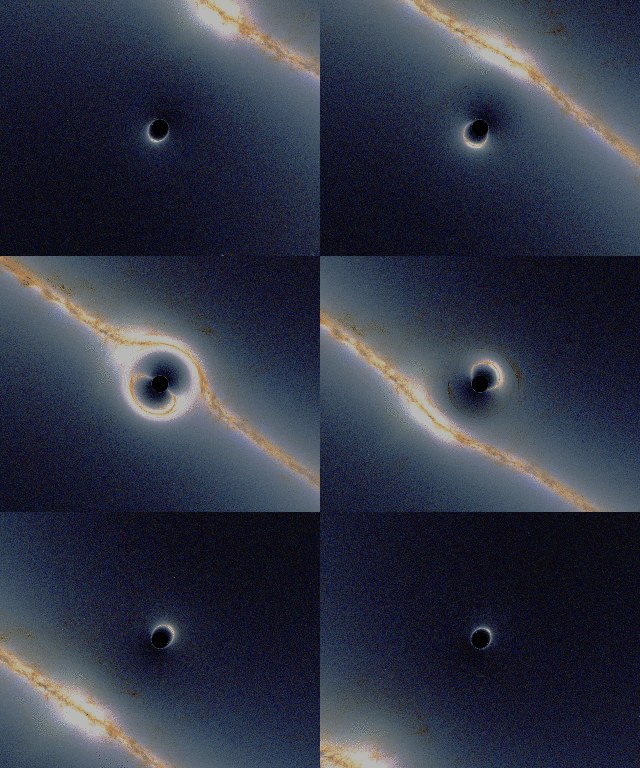
 
A simulation of gravitational lensing around a black hole and a galaxy

Many of the properties of black holes are well documented, yet the formation and growth of supermassive black holes are on the cutting edge of astrophysics. Black holes usually form out of supernovas – the explosions at the end of a star's lifespan. In young or middle-aged stars, the energy created by nuclear fusion counteracts gravity, and keeps a star from collapsing into a black hole. When a massive star reaches the end of its lifespan (when it has burned all the fuel inside of it), it explodes in a phenomenon known as a supernova. Because fusion cannot occur in the remnants of a supernova, when there is not enough energy for the supernova to counteract gravity, there is nothing to prevent the remaining matter from collapsing into a dense object, such as a black hole. By astronomical standards, only supermassive stars have enough matter to become black holes, so small stars, including our sun, merely compact into white dwarfs or neutron stars. (Spoiler alert: the sun will eventually become a white dwarf, so there is no danger of it becoming a black hole.) Scientists know more about the creation of stellar-mass black holes than about the creation of supermassive black holes, but there is a possibility that stellar-mass black holes can grow to a supermassive size by rapidly consuming the matter around them.

Once a black hole forms, it can continue to grow by absorbing more and more matter. The following is theoretical. For example, in binary star systems containing two large stars, the first star to become a black hole will absorb matter from its companion star until the younger star vanishes. When black holes are too far from stars to absorb their matter, they consume the dust and gas floating around them. When two black holes collide, it has been hypothesized that they merge together to become an even larger black hole, producing a whopping amount of energy and sending ripples known as gravitational waves through the universe. 
 A stellar-mass black hole in a binary star system

So far, the only observations of gravitational waves have been contradicted by other, more detailed observations. However, as pairs of supermassive black holes at the centers of distant galaxies spiral closer and closer to each other, the chances are good that we will eventually be able to observe and study such dramatic black hole growth.

In the upcoming Marin Science Seminar, "Snacking, Gorging, and Cannibalizing: The Feeding Habits of Black Holes," astrophysicist Steve Croft, Ph.D. will discuss how innovative telescope technologies make it possible to observe the growth of black holes in a new way, and perhaps, track disappearances from laundry baskets, tables, and refrigerators once and for all

For more information, come to the next Marin Science Seminar at Terra Linda High School from 7:30-8:30 p.m. on March 11th, 2015.

Sources:
Image Credits:

Tuesday, February 24, 2015

Why Do We Age?

By Angel Zhou, Branson School


Why do we age? It might seem like a silly question, but scientists have asked it in hopes that they might one day counteract the process.

Never before have so many people lived for so long. Life expectancy has nearly doubled over the last century, and today there are 36.8 million Americans age 65 and older. Longer life has obvious appeal, but it entails personal hardships and financial burdens. In addition to personal hardship, there is also a cost to society. The financial burden of treating the chronic diseases of aging is expected to rise steadily as Baby Boomers get older. Politics may come to be dominated by the old, who might vote themselves ever more generous benefits for which the young must pay. If longer life expectancy simply leads to more years in which pensioners are disabled and demand expensive services, health-care costs may balloon as never before, while other social needs go unmet.

Since 1999, scientists have studied ways to make organisms live much longer, and with better health than they naturally would.  Previous research assumed that chronic diseases arise and should be treated individually. What if, instead, aging is the root cause of many chronic diseases, and aging can be slowed?


The Buck Institute for Research on Aging (http://www.buckinstitute.org) is the nation’s first independent research facility focused solely on understanding the connection between aging and chronic disease. At the Buck Institute, world-class scientists work in a uniquely collaborative environment to understand how normal aging contributes to the development of conditions specifically associated with getting older such as Alzheimer’s and Parkinson’s diseases and cancer. Their interdisciplinary approach brings scientists from disparate fields together to develop diagnostic tests and treatments to prevent or delay these maladies and to ultimately increase the healthy years of life.

The aging of our population — in past decades and in the foreseeable future — presents both a challenge and an opportunity for all of us as we seek to stay healthy throughout our longer lives. If medical interventions to slow aging result in added years of reasonable fitness, life might extend in a sanguine manner, with most men and women living longer in good vigor, and also working longer, keeping pension and health-care subsidies under control. Indeed, the most exciting work being done in longevity science concerns making the later years vibrant, as opposed to simply adding time at the end.


In his Marin Science Seminar, Dr. Lithgow (http://buckinstitute.org/lithgowLab) of the Buck Institute will discuss the mechanisms of aging by identifying agents that extend lifespan or prevent age-related disease and solutions to eventually eradicate the chronic diseases of late life.

Join us this Wednesday, February 25 for this week's Marin Science Seminar "Do We Have to Grow Old? The New Science of Aging " with Gordon Lithgow, Ph.D. of the Buck Institute in Room 207 at Terra Linda High School in San Rafael. For more information, visit Marin Science Seminar's Facebook page: https://www.facebook.com/events/870825009620005/.

Monday, February 23, 2015

Teaser vid for "Do We Have to Grow Old: The New Science of Aging" Marin Science Seminar

Join us Wednesday, February 25th, 2015 at Terra Linda High School in San Rafael for 

Do We Have to Grow Old? The New Science of Aging 

with Gordon Lithgow PhD of the Buck Institute for Research on Aging, Novato

Aging remains one of the most mysterious processes in science. It is also the leading cause of chronic diseases such as cancer and Alzheimer's disease. Gordon Lithgow studies the basic science of aging at the Buck Institute in Novato. He will talk about what we know about the mechanisms of aging and what scientists are doing to slow aging and eventually eradicate the chronic diseases of late life.

Teaser video below by MSS Intern Talya Klinger, Homeschooler

Tuesday, February 10, 2015

Interview with Art Wallace, MD PhD on Big Data and Medical Innovation


By Angel Zhou, Branson School


Mobile technologies, sensors, genome sequencing, and advances in analytic software now make it possible to capture vast amounts of information that could transform medicine. The question is: can Big Data make health care better?

In the upcoming Marin Science Seminar, "Big Data and Medical Innovation," Dr. Art Wallace, Chief of Anesthesia Service at the San Francisco VA Medical Center and a Professor of Anesthesiology and Perioperative Care at UCSF Medical Center, will discuss applications of Big Data in medicine and how Big Data has changed epidemiology, quality improvement, and drug discovery. Read the following interview to learn more about Dr. 

Wallace’s thoughts on Big Data and its impact on medical innovation.

Art Wallace, MD PhD

What is Big Data and what is its significance to medicine?  What makes Big Data different from other data that people work with in the healthcare industry?

Big Data is data that is acquired for other purposes that can be analyzed to understand processes, people, and systems. Big Data includes many things: cell phone records, super market purchase card records, credit card records, medical records, internet search terms, medication usage, hospital admissions, social security records, etc. This data can be used for epidemiology to identify associations between factors and outcomes.

Big Data gives additional power to identify factors associated with rare outcomes. I can now easily do a study in 1 million people using data collected for administrative purposes. Doing a study in 1 million patients used to be enormously expensive, now it just requires computer programming and epidemiologic analysis. Before Big Data, the cost of collecting data was prohibitive, so many studies could not be done. With Big Data, there is little to no cost of collecting the data, making the analysis the entire cost for large studies. The profoundly lower costs with Big Data techniques make studies that were previously impossible, possible at minimal cost.

How does Big Data impact professionals in the medical field? Can Big Data be used to improve healthcare?

We have identified factors associated with adverse outcomes, identified medication practices that are associated with increased mortality, identified medications that can reduce morbidity and mortality, and we have identified possible therapies for diseases that have no current therapy. We can reduce morbidity, mortality, cost, and assist in the development of new therapies.
  
Big Data can be used to reduce morbidity, mortality, cost, and improve efficiency. Big Data can be used to ask questions that are morally, politically, technically, socially, ethically, or legally impossible to answer with randomized trials. Big Data is being used to improve quality of life while lowering costs.

Describe how Big Data is reshaping the drug industry?

Big Data can be used to identify medications that reduce or increase risks. Post marketing testing can identify medications that have significant associated morbidity and mortality. For example, we identified a drug that increased mortality risk 5 fold (increased from 3 to 15% with drug use). This use of Big Data led to a medication being taken off the market. It had been used in Europe for 30 years, in the U.S. for 10 years, and it increased the risk of death from 3 to 15%. Big Data was used to identify a very serious risk to patients and led to the medication being taken off the market.

How will Big Data accelerate innovation in medicine?

Big Data will be used to identify new uses of medications. It will identify risk factors for morbidity and mortality. It will lead to further randomized trials.

What are the benefits and dangers of providing Big Data online as the "ever expanding cloud of information" becomes more accessible?

It is easy to identify people from their digital detritus. It is easy to identify very personal things about people from their data trails. Factors such as financial status, interests, sexual orientation, political beliefs, religious beliefs, health status, pre-existing medical conditions, drug and alcohol use, pregnancy status, and proclivities can all be assessed via Big Data. Big Data can be used to manipulate, track, and market to people. At the same time, Big Data can identify very serious risks to patients’ health. Scientific method is an approach; Big Data is a tool. Both can be used for good or bad purposes. Big Data is simply a new and extremely powerful scientific tool.   


Join us Wednesday, February 11th, 2015 to learn more about "Big Data and Medical Innovation" with Dr. Art Wallace from 7:30 - 8:30 PM Terra Linda High School, San Rafael in Room 207.

Friday, February 6, 2015

Big Data and Medicine - Teaser video

Join us Wednesday, February 11th, 2015 at Terra Linda High School in San Rafael for 

Big Data and Medicine 

with Art Wallace MD PhD of UCSF & VAMSC SF

Dr. Wallace will discuss the use of big data in the scientific development of medical care.  He will describe how big data has changed epidemiology, quality improvement, and drug discovery using examples from the U.S. Veteran’s Administration.

Teaser video below by MSS Intern Ben Foehr of Terra Linda High School


Sunday, January 25, 2015

Spring 2015 Marin Science Seminar schedule

Join us for our 8th year of free science learning in Marin!  Six Wednesday evenings per semester from 7:30 - 8:30 pm at Terra Linda High School, 320 Nova Albion, San Rafael, CA 94903

FEBRUARY - Big Data and Medicine

11: "Big Data and Medical Innovation" with Art Wallace MD PhD of UCSF and VAMC SF

25: "Do We Have to Grow Old? The New Science of Aging" with Gordon Lithgow PhD of the Buck Institute, Novato
MARCH - Astronomy & Particle Physics

11: "Snacking, Gorging, and Cannibalizing: The Feeding Habits of Black Holes" with Steve Croft PhD of UC Berkeley

25: "Extra dimensions, mini black holes and.. Pink Elephants?: Exciting times ahead at the Large Hadron Collider" with Lauren Tompkins of Stanford University
APRIL - Ecology & Genetics

1: "From Monkey Flowers to Wild Mice: A Tale of Genes, Adaptation and Extreme Environments" with Katie Ferris PhD of UC Berkeley's Museum of Invertebrate Zoology

8: "Let's Learn About Lysosomes" with Gouri Yogalingam PhD of Biomarin

Monday, December 29, 2014

Spring 2015 Marin Science Seminar internship application period now open

Explore science & technology, meet scientists and medical professionals, gain experience for your resume and college applications, develop a portfolio! Our past interns are now studying at CalTech, UC Berkeley, UC Davis, UC Santa Cruz, Cal Poly SLO, Sonoma State, and CSU Chico. Check out our blog and Vimeo page for examples of past intern blogging and videography. More info. on our internship website.

Apply Online Today or email marinscienceseminar@gmail.com if you are interested in applying. Below is a comparison of the internships currently being offered. Deadline to apply is Friday, January 16th at 5 pm.

Marin Science Seminar Writing Marin Science Seminar Photography &/or Videography
Attend and assist at MSS sessions, 6 Wednesday evenings per semester, 7 - 9pm Attend and assist at MSS sessions, 6 Wednesday evenings per semester, 7 - 9pm
At Terra Linda High School, San Rafael, Room 207 At Terra Linda High School, San Rafael, Room 207
Submit 2 writing samples Submit 2 video samples or photography portfolio
Familiarity with basic blogging interfaces (e.g. Tumblr, Blogger, Wordpress) Able to edit video using video editing software, manage Instagram & Vimeo accounts
Facebook account Facebook account
Training in blogging software provided Recording equipment and SC cards provided
JokeMSS interns attend and assist with a minimum of 6 science seminars per academic year (there are 12 per year) during which they meet the speakers and assist with various logistical duties. Sessions take place on Wednesday evenings at Terra Linda High School, Room 207, during the school year. Interns arrive evening of a session at 7 pm and are free to leave once breakdown is completed (between 8:30 and 9 pm). 

Interns also assist in researching and creating materials about event topics, creating and distributing outreach materials, social networking and online development of Marin Science Seminar’s mission to attract more students to the fields of science, technology and math. Other than attending MSS sessions, duties will depend on student interests and background. Training is provided for some intern tasks.

Interview with Irfan Kathiriya: How to Make or Break Your Heart

By: Sahiti Namburu School: Terra Linda High School Dr. Kathiriya is a pediatric cardiac anesthesiologist and Professor of Anesthesia at t...

About Us

Marin Science Seminar is a one-hour science lecture/presentation with a question and answer period open to all interested local teenagers, educators and community. Seminar sessions are held 12 Wednesday evenings during the school year, from 7:30 to 8:30 pm in the Innovation Hub at Terra Linda High School, 320 Nova Albion Way, San Rafael. Seminar speakers are scientists, mathematicians, engineers, physicians, technologists and computer programmers. The topics presented are in a specific area of the speaker’s expertise, geared to interested high school students.