Wednesday, November 30, 2022

Covid-19 and Long COVID: Rapidly Developing Therapies for a New Disease

 On November 30, 2022 Art Wallace presented studies and statistics on a new disease, Long  COVID.

Art Wallace, MD PHD
Art Wallace, MD PHD


Art Wallace introducing himself!

He explained the problems with Covid variants and why Long COVID presents negative long term effects.
Explaining their research objectives!


Learn more about Covid-19 and Long COVID at Marin Science Seminar!

Covid-19 and Long Covid Seminar Teaser

 COVID-19 AND LONG COVID: RAPIDLY DEVELOPING THERAPIES FOR A NEW DISEASE

By Art Wallace, MD, PhD

November 30th, 2022 


Thursday, November 17, 2022

“Blinded by the Lack of Light: Genetics of Pigmentation and Eye Loss in Cave-dwelling Crustacean” - An Interview With Meredith Protas Ph.D. of Dominican University of California

 by Samantha Dvorin, Archie Williams High School 

Meredith Protas is an associate professor and MS Biological Sciences Director at Dominican University. Her lab investigates the evolution and genetics of cave-dwelling creatures like crustaceans. Previously, she did research at UC Berkeley on cave-dwelling crustaceans and studied the genetic basis of human eye disease at UCSF. She has a B.A. in biology from Pomona College and a Ph.D. in Genetics from Harvard. On Wednesday, November 16, 2022, Dr. Protas presented The Genetics Behind Eye Degeneration in Cave-dwelling Crustaceans at the Marin Science Seminar. We asked her some questions about what she does.

1. What made you interested in studying cave crustaceans and evolutionary biology in general?

I felt like there were a lot of interesting questions in cave biology and I wanted to understand how the same things (like eye loss and loss of pigment) happened in very different organisms.

 2. How are the cave-dwelling and surface-dwelling forms of the isopod crustacean different?

There are lots of things, but some examples include loss of eyes, loss of pigment, and longer antennae.

3. What is your favorite crustacean or cave-dwelling creature in general?

I like Proteus anguinus, which is a cave-dwelling salamander. It’s known for having an unusually long lifespan.

Proteus anguinus, also known as Olm

4. Since many animals lose traits they no longer need (like how many cave animals lose their eyes and pigment), are there any traits you think humans will lose as we continue to evolve?

That’s a good question- it’ll depend if losing something doesn’t cause some extra negative things from happening but also if there is an advantage to that loss. Also, it’ll depend if the loss gives humans a reproductive advantage.

5. What is hands-on field work like (ie. exploring caves and collecting samples)?

We don’t do much of this currently, but I have gone to caves to collect animals. Then we bring them to the lab and work with them there.

 6. What does a day in the lab with your Dominican University students look like?

We tend to do a lot of molecular work- PCR, DNA extraction, and gel electrophoresis.

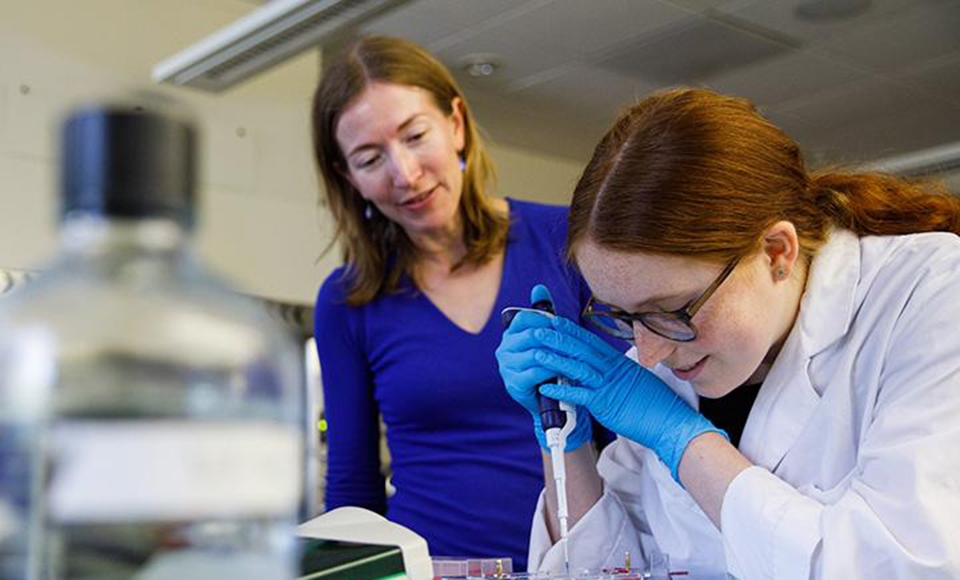
Dr. Protas in the lab with a student

7. What advice would you give to young people interested in genetics and scientific research?

Find some interesting questions and see how you can be a part of answering them.

8. Are there any projects you are working on right now?

Yes, using some genomic techniques and also looking at variation present in the surface form.

Dr. Protas' Zoom Seminar

Learn More:

- https://works.bepress.com/meredith-protas/

- https://marinscienceseminar.com/blinded-by-the-lack-of-light/

Wednesday, November 16, 2022

The Genetics Behind Eye Degeneration in Cave-dwelling Crustaceans

 On November 16, 2022. Dr. Meredith Protas gave a presentation on zoom to share how genes and mutations are responsible for cave-specific characteristics in organisms!

Introduction to presentation.


Dr. Protas gave everyone opportunities to showcase their knowledge asking them driving questions!

Question- "How do unique characters evolve?"


We all learned a lot about cave animals and the traits that make them unique!

Cave Animals and their characteristics!

Dr. Protas explained how cave animals have no eyesight and are different colors compared to their terrestrial cousins.

What makes cave animals different?

Learn more about Cave-dwelling Crustaceans at Marin Science Seminar!

Wednesday, November 9, 2022

I'm a Botanist (and unfortunately I don't know why your succulent isn't flowering!)

 On November 9, 2022, Dr. Sarah Jacobs came to Terra Linda to share the field work and responsibilities of a Botanist.

Texas Indian Paintbrush

Dr. Jacobs starts the presentation with a story of how she became a botanist.

Steps to becoming a botanist

Dr. Jacobs explains the role of a systematic botanist and museum scientist and how they collect data from the field to classify plants.

Systematic botany
Systematic botany

To learn more about Botany and the best parts of it visit Marin Science Seminar!

Sunday, October 30, 2022

"Understanding Air Quality Data in the Bay Area" - An Interview With Michael Flagg of the Bay Area Air Quality Management District

by Samantha Dvorin, Archie Williams High School 

Michael Flagg is a principal air quality specialist at the Bay Area Air Quality Management District (BAAQMD) in the Ambient Air Quality Analysis Office Section. Prior to working at BAAQMD, Flagg worked at the EPA’s Region 9 Air Quality Analysis for 10 years where he was a national expert on air monitoring, quality assurance and control, and data analysis regarding federal policy decisions. He has a bachelor’s degree in Environmental Engineering from California Polytechnic State University, San Luis Obispo. On Wednesday, October 12, 2022, Flagg presented Understanding Air Quality Data in the Bay Area" at the Marin Science Seminar. We asked him some questions about what he does.


1. How does air quality monitoring using professional high-tech equipment differ from monitoring with air sensors that any person can purchase?


The main difference is the purpose of the monitoring. The high-tech equipment the Air District uses in its air monitoring sites is used to track air quality over time, ensure compliance with health-based air quality standards, and provide accurate information to the public. Air sensors are typically used for collecting air quality data in lots of different places. Community groups use these networks to determine where air quality may be higher and use that information to advocate for a reduction in emissions. Also, the high-tech equipment is very expensive and takes full-time employees to run every day, while sensors are relatively cheaper and easier to operate.


2. What does a day at the Bay Area Air Quality Management District look like for you?


A typical day starts with checking my email for any new incoming requests for data analysis, input on different projects, or answering questions about air quality and air monitoring. Generally, I try to look a the most recent air quality data every day to stay informed about what is happening in the Bay Area. Most of my time is working on specific projects, like data analysis, working with community groups on air monitoring, or reviewing documents.

Image from Flagg's San Francisco Chronicle Article

3. Why do you think air quality and pollution management are so important?


Breathing clean air is a basic human right and the Air District's mission is to reduce air pollution for all Bay Area residents. This is especially important in communities of color that have experienced decades of environmental racism and are exposed to higher levels of pollution than other groups.


4. How has the world of air quality management changed since the emergence of new air monitoring technology?


It really has made collecting air quality data easier, which empowers people to understand the air quality in their neighborhoods and advocate for changes.


5. How is air pollution not only an environmental problem but also a social/equality issue?


Through policies like redlining, communities of color live in close proximity to more sources of air pollution than other groups. These communities experience disproportionate levels of exposure to poor air quality and as an agency need to work toward reducing air quality in the Bay Area in an equitable way - meaning we should be working to reduce air pollution in the worst areas first.


6. How can people get involved with improving air pollution and advocating for a cleaner world?


Engaging with all levels of government and advocating for clean air or working with community-based organizations to raise awareness about air quality and how to get local improvements are a few examples.


7. What advice would you give to a young person interested in environmental protection and air quality work?


Learn about air quality in your area and connect with like-minded people that are passionate about environmental protection, whether that be a group of friends or a local organization.


8. Are there any projects you are working on right now?


I am working on quite a few different projects, but right now I am working on a program called the Bay Air Center that provides technical support on air monitoring and air quality to local community groups that are interested in collecting data with air sensors or advocating for cleaner air in their community.


Learn More:

Interview with Irfan Kathiriya: How to Make or Break Your Heart

By: Sahiti Namburu School: Terra Linda High School Dr. Kathiriya is a pediatric cardiac anesthesiologist and Professor of Anesthesia at t...

About Us

Marin Science Seminar is a one-hour science lecture/presentation with a question and answer period open to all interested local teenagers, educators and community. Seminar sessions are held 12 Wednesday evenings during the school year, from 7:30 to 8:30 pm in the Innovation Hub at Terra Linda High School, 320 Nova Albion Way, San Rafael. Seminar speakers are scientists, mathematicians, engineers, physicians, technologists and computer programmers. The topics presented are in a specific area of the speaker’s expertise, geared to interested high school students.