
Saturday, October 28, 2023


Friday, October 20, 2023
Photos : What an AI Can Teach Us About the Human Mind
By: Adriana Sarahi Martinez
What Can AI Teach Us About the Human Mind... and vise versa with Irina Rabkina
Irina does a psychological test with children to explain how the human mind works
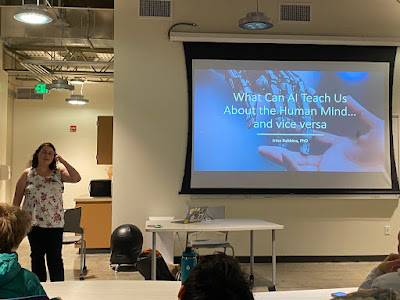
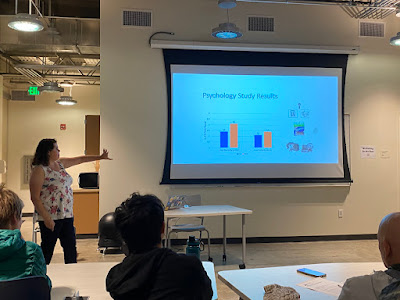
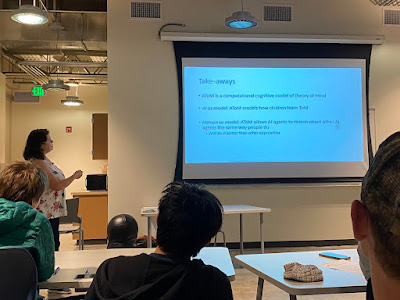
This is from the talk What Can AI Teach us About the Human Mind… and vice versa? at Tera Linda High School on October 11, 2023.
Friday, September 29, 2023
Unveiling the Secrets of Volcanoes
By : Adriana Sarahi Martinez
Unveiling the Secrets of Volcanoes : Marissa Mnich
Thursday, August 10, 2023
A DeepDive into BioAstronautics and Space with Ben Foehr
By Disha Divakar, San Marin High School

Whether it was as kids pretending cardboard boxes were space shuttles or being fascinated by Star Wars, spaceflight has been a dream for many! In reality, we often forget the factors that have to be thought through when sending a human to space and a lot of times we don't always know of the infinite mysteries and possibilities the galaxy holds! In this interview, Ben Foehr (BS in Aerospace Engineering and Grad Student studying Human Spaceflight at CU Boulder) dives more into his work and emphasis on Bioastronautics and Aerospace engineering and addresses some questions as we enter a new age of space exploration! Ben presented Path to the Stars: Exploring Bioastronautics for the Marin Science Seminar on February 15th.

Fun Fact: He has worked on Cubesats, Sounding Rockets, and proprioceptive function research for astronauts
 |
| Ben Foehr |
In my opinion, the biggest issues in Bioastronautics are the issues faced by Astronauts on long duration space flights. Space is an incredibly hostile environment even for short visits, but the longer we stay in outer space, the more our bodies are negatively affected. Extended microgravity leads to things like bone loss, muscle atrophy, and vision problems, while the constant noise and high stress environment found aboard spacecraft and space stations lead to most astronauts having really messed up sleep schedules for months on end, and having to fight through a bunch of different types of fatigue to get any work done. And that's just for Earth orbit: the further out we go towards places like the Moon or Mars, the more of an issue things like isolation from support and deadly radiation becomes, which is its own set of huge issues! So, overall, a lot of my field's focus is on figuring out how the heck we'll be able to keep all our astronauts happy, healthy, and productive when we start living in space for more than just a few weeks or months.
What particular factors do you consider when sending a human through space flight? How do you develop the right conditions for a human to travel in space for long periods of time?
For spaceflight, we start by considering all of the parts of our environment here on Earth we have to bring with us into space for our crew to survive: an atmosphere we can breathe, food we can eat, water we can drink (then recycle and drink again). We also have to think about less obvious parts of our everyday environment, like what tools and skills a crew will need to conduct their mission successfully, or what unexpected factors might make things more complex, like how we'd deal with a surprise medical emergency, or sudden tensions between the crew. Luckily, the best way to prepare for these missions is to look at previous missions: we've sent around 628 people to space so far, and while that a very small number of data points for most scientific studies, all of these previous explorers can tell us a lot about what worked on their mission and what didn't, so we can prepare for how we want to do things different next time. The ISS has been especially helpful, as crews staying abroad for 6 months or more will give a LOT of feedback about how they felt in terms of physical and mental health, their ability to get their job done, and what they would have liked to have during their stay to make things better.
For spaceflight, we start by considering all of the parts of our environment here on Earth we have to bring with us into space for our crew to survive: an atmosphere we can breathe, food we can eat, water we can drink (then recycle and drink again). We also have to think about less obvious parts of our everyday environment, like what tools and skills a crew will need to conduct their mission successfully, or what unexpected factors might make things more complex, like how we'd deal with a surprise medical emergency, or sudden tensions between the crew. Luckily, the best way to prepare for these missions is to look at previous missions: we've sent around 628 people to space so far, and while that a very small number of data points for most scientific studies, all of these previous explorers can tell us a lot about what worked on their mission and what didn't, so we can prepare for how we want to do things different next time. The ISS has been especially helpful, as crews staying abroad for 6 months or more will give a LOT of feedback about how they felt in terms of physical and mental health, their ability to get their job done, and what they would have liked to have during their stay to make things better.
What was the most influential project you have worked on?
So far, the most influential project I've ever worked on was a week-long design workshop hosted by the ESA and the University of Stuttgart out in Germany. There, I was one of only two Americans invited to work with a group of 40 other college students from all across the world who were interested in space exploration to design a realistic and workable concept for a space station that could be built some day in the near future. Obviously, designing a space station like this was incredibly cool and exciting, but in my opinion, working with an international group like this really opened my eyes to the different ways people all over the planet engage with space exploration, and I was able to make some lifelong friends in the process! It was a ton of work, and I didn't sleep much that week, but I came out of it more excited about my field than ever before.
So far, the most influential project I've ever worked on was a week-long design workshop hosted by the ESA and the University of Stuttgart out in Germany. There, I was one of only two Americans invited to work with a group of 40 other college students from all across the world who were interested in space exploration to design a realistic and workable concept for a space station that could be built some day in the near future. Obviously, designing a space station like this was incredibly cool and exciting, but in my opinion, working with an international group like this really opened my eyes to the different ways people all over the planet engage with space exploration, and I was able to make some lifelong friends in the process! It was a ton of work, and I didn't sleep much that week, but I came out of it more excited about my field than ever before.
Do you think it is going to be necessary for humans to relocate to a new planet soon? When do you think Earth’s conditions will become inhabitable/unsuitable for us?
This is a question I hear often, and I totally understand why a lot of people think leaving the Earth might be our only option. As climate change worsens and our planet begins to suffer from the effects of pollution, it often feels like fleeing to the stars and finding somewhere safe where we can survive might be our only chance to survive. But space is an incredibly inhospitable place, and keeping just two or three humans alive on places like the Moon or Mars even for a few days is a really, really difficult task, so with current technology it's basically impossible to strike out in search of a new home. But this doesn't mean we should give up hope: humans are incredibly resilient, and just the fact that we're even able to send people off-world for long periods of time is proof that we can adapt to harsh environments and overcome incredible problems! I think one day we will see humans living on another world, but, in my opinion, I think something like that will only ever be possible once we figure out how to fix our problems on Earth. But I believe in us, and think we will be able to pull it off! And after that, as they say, I think the sky's the limit!
This is a question I hear often, and I totally understand why a lot of people think leaving the Earth might be our only option. As climate change worsens and our planet begins to suffer from the effects of pollution, it often feels like fleeing to the stars and finding somewhere safe where we can survive might be our only chance to survive. But space is an incredibly inhospitable place, and keeping just two or three humans alive on places like the Moon or Mars even for a few days is a really, really difficult task, so with current technology it's basically impossible to strike out in search of a new home. But this doesn't mean we should give up hope: humans are incredibly resilient, and just the fact that we're even able to send people off-world for long periods of time is proof that we can adapt to harsh environments and overcome incredible problems! I think one day we will see humans living on another world, but, in my opinion, I think something like that will only ever be possible once we figure out how to fix our problems on Earth. But I believe in us, and think we will be able to pull it off! And after that, as they say, I think the sky's the limit!
Will space exploration start affecting everybody’s life and become a normality/reality for people other than astronauts?
I think space exploration already does affect everyone's life down on Earth, it's just hard to see sometimes. A lot of technology we use everyday like GPS, compact computers, Solar Panels, and even velcro was developed for space exploration, and current missions are helping innovate and create new and exciting technology. In terms of traveling to space, I also think that's something we'll see more and more of: right now it's fairly exclusively either rich tourists or highly selected scientists, which is generally out of reach for regular people. But as more nations and organizations travel out into space, more people will go too, and it would not surprise me that, within the next 100 years, we see space exploration more as people saw sailors on old exploring and trading ships: a rough lifestyle and still a fairly exclusive group, but something regular people could, with the commitment, become a part of. And beyond that, I one day hope that everyone can go to space as easily as going on any other trip, or moving to any other place on Earth!
I think space exploration already does affect everyone's life down on Earth, it's just hard to see sometimes. A lot of technology we use everyday like GPS, compact computers, Solar Panels, and even velcro was developed for space exploration, and current missions are helping innovate and create new and exciting technology. In terms of traveling to space, I also think that's something we'll see more and more of: right now it's fairly exclusively either rich tourists or highly selected scientists, which is generally out of reach for regular people. But as more nations and organizations travel out into space, more people will go too, and it would not surprise me that, within the next 100 years, we see space exploration more as people saw sailors on old exploring and trading ships: a rough lifestyle and still a fairly exclusive group, but something regular people could, with the commitment, become a part of. And beyond that, I one day hope that everyone can go to space as easily as going on any other trip, or moving to any other place on Earth!
What are your hopes for the future of space exploration? What do you want to see?
There is a lot I hope to one day see in regards to space exploration, but my number one dream would be to see us explore space and live on new worlds in a way that shows improvement for humanity beyond what we've done before. Back during the Cold War, for example, even though tensions were extremely high between the US and the Soviet Union, the joint Apollo/Soyuz mission in 1975 saw the two "opposing" crews quickly become fast friends, bonding over their shared humanity and love of exploration! In the future, I hope to see more events like this, where different people from different nations, creeds, and backgrounds can still explore space under common goals. I'd love to see, for example, international collaboration on Moon and Mars missions not just with NASA and ESA, but other space agencies like the Chinese National Space Administration, or the Indian Space Administration, or any other nation that wants to be a part of this journey. If we want to go to the Moon, Mars, or beyond, we need to go together, and I hope to one day see that become reality.
There is a lot I hope to one day see in regards to space exploration, but my number one dream would be to see us explore space and live on new worlds in a way that shows improvement for humanity beyond what we've done before. Back during the Cold War, for example, even though tensions were extremely high between the US and the Soviet Union, the joint Apollo/Soyuz mission in 1975 saw the two "opposing" crews quickly become fast friends, bonding over their shared humanity and love of exploration! In the future, I hope to see more events like this, where different people from different nations, creeds, and backgrounds can still explore space under common goals. I'd love to see, for example, international collaboration on Moon and Mars missions not just with NASA and ESA, but other space agencies like the Chinese National Space Administration, or the Indian Space Administration, or any other nation that wants to be a part of this journey. If we want to go to the Moon, Mars, or beyond, we need to go together, and I hope to one day see that become reality.
Friday, April 21, 2023
"Don’t Whack that Whale!: Evaluating Risk of Ship Strike to Humpback Whales" -- an interview with Bekah Lane
Sabine Fuchs, Katherine Branson School
Vessel strike is a leading cause of death for large whales, and San Fransisco Bay is no exception. Beneath the complex and intricate surface traffic of the bay, from recreational boats to shipping tankers, these majestic creatures weave their way through the water. Due to the fatal nature of this boat traffic, it’s imperative to study the overlap between vessels and whales in San Francisco Bay. Bekah Lane, a Cetacean Field Research Specialist at the Marine Mammal Center in Sausalito, used vessel data from 2016 to 2019 in the Bay and compared it against whale sightings from that same period, forming a ship strike risk analysis for humpback whales to better inform boaters. Before this, Lane also created a theodolite tracking program for humpback and gray whales in San Francisco Bay, coordinating more than 40 volunteers. Lane received her B.S. in Zoology from Emporia State University and an M.S. in Marine and Estuary Sciences from San Francisco State University. This April, Lane presented Don’t Whack that Whale!: Evaluating Risk of Ship Strike to Humpback Whales in San Francisco Bay at Marin Science Seminar.
 |
| Bekah Lane of the Marine Mammal Center |
1. As someone raised in Wichita, Kansas, away from the ocean, what inspired you to work with whales? Was there a defining moment, or was it a lifelong dream?
I have wanted to be a whale biologist for as long as I can remember, even before I ever saw the ocean. I remember watching documentaries on National Geographic and thinking: THAT'S the job I want! To a little girl from Kansas, whales and dolphins seemed like mythical creatures to me. Even though I see them almost daily in my work, I am still so amazed and inspired by them!
2. Have you faced any challenges in your career as a woman in STEM?
I have absolutely faced challenges in my career as a woman in STEM. While there are currently a lot of women interested in marine science, it hasn't always been that way, and my female supervisors were among the only women in their programs when they were getting their advanced degrees. For me, the biggest struggle has been gaining technical skills such as small boat operations, and there are still aspects of the field, like tagging, that seem to be dominated by men. In the early parts of my career, I really struggled to get my male supervisors to teach me how to do things like trailer and drive boats, even though my male coworkers were given ample opportunities to practice these skills. I still get funny looks when myself and my all-female field crew pull up to the fuel dock!
 |
| A Humpback Whale, image by Todd Cravens |
3. Collisions between boating vessels and whales seem preventable if only the whale could move away quickly. Are whales simply unable to hear the oncoming boat? If so, what is the biological explanation?
This is a common question, and there are a variety of factors that make it difficult for whales to evade ships in the water. For one, these whales evolved over a very long period of time in the absence of ships this size, and thus are not adapted to respond to a "predator" of this kind - additionally, there isn't an opportunity for learning between generations, since strikes from large ships are almost always lethal. Another factor is that some of these vessels are so large that the part of the boat that makes the noise that could signal the whale should leave the area to avoid being struck can be up to THREE FOOTBALL FIELDS away from the part of the boat that strikes and kills the whale. Lastly, the ocean, and especially San Francisco Bay, is exceptionally loud due to the sheer amount of vessel traffic. Think about when you're in a huge, crowded room where everyone is talking... you may be able to hear people talking, but it can be hard to make out the specifics of a conversation unless you are very focused. When whales are in the Bay, they are focused on the challenging task of feeding themselves about 2 tons of fish and anchovy per day, so I imagine it must be hard to make out sounds from specific ships and evade them in a timely fashion. Unfortunately, it's not as simple as the whales hearing the vessel and getting out of the way quickly.
4. What role does boater education play in preventing whale collisions?
Boater education and outreach are crucial when it comes to preventing collisions between recreational vessels and whales. Most people who go boating in San Francisco Bay aren't aware that there are gray whales and humpback whales using the Bay during different times of the year or of any of the laws around observing marine mammals from vessels. At The Marine Mammal Center, we are also working with shipping companies and other maritime stakeholders to find ways to lower the risk of ship strikes to whales in the Bay.
5. In what ways can we lower the risk of whales getting hit?
Boat operators and captains can reduce the risk of vessel collisions with whales by slowing down and staying the mandatory 100 yards away from whales and other marine mammals while on the water. As consumers, we can also shop locally to reduce the amount of distance our goods have to travel to reach us, and thus reduce the amount of interaction between ships and wildlife.
Thursday, April 20, 2023
Humpback Whales: an Illustration by Sabine Fuchs
 |
| Ink Drawing by Sabine Fuchs |
Sabine Fuchs is an intern for Marin Science Seminar who took inspiration from Bekah Lane's presentation at MSS to create an illustration of the majestic creatures Lane studies. To learn more about Humpback whales in San Fransisco Bay and why they are at risk, take a look at Sabine Fuchs's interview with Bekah Lane.
Thursday, March 2, 2023
"The HiggsBoson: 10 Years On" -- An Interview with Miha Muškinja Ph.D. of Lawrence Berkeley Labs
By Sabine Fuchs, Katherine Branson School
One of the most complex discoveries in particle physics, the Higgs boson, recently celebrated its 10th anniversary last July. Miha Muškinja, who is originally from Slovenia, is a postdoctoral researcher in physics at Lawrence Berkeley Lab. Muškinja worked on the ATLAS experiment, which announced the discovery of the Higgs boson, at the Large Hadron Collider (LHC) at CERN near Geneva, Switzerland. Recently, he moved to Berkeley, California, where he specializes in analyzing the properties of the Higgs boson, in addition to working on algorithms and infrastructure to process data by the LHC. In March of 2023, Muškinja presented The HiggsBoson: 10 Years On at Marin Science Seminar and explained what the Higgs boson is, its significance, and its discovery in 2012.
Q1: How did you become interested in particle physics?
During elementary and high school, I had a strong fascination with mathematics, physics, and chemistry. It became evident early on that I would pursue studies in one of these fields. On July 4th, 2012, I watched the live stream of CERN's announcement regarding the discovery of the Higgs boson, which was delivered by Fabiola Gianotti, the spokesperson of the ATLAS experiment at that time and now the Director General of CERN. This event sparked my interest in particle physics and solidified my decision to study physics with the goal of becoming a scientist at CERN. Although it seemed like an impossible task at the time, my dream came true six years later when I began my Ph.D. in particle physics with the ATLAS experiment at CERN.
Q2: What advice would you give someone interested in pursuing a career in particle physics?
The theoretical framework of particle physics, known as the Standard Model, is built upon a complex mathematical framework called Relativistic Quantum Field Theory (QFT). This theory is among the most difficult you will encounter at any university, so it is crucial to study diligently. You will need to acquire a high level of understanding in both physics and mathematics to be comfortable with the Standard Model. Additionally, programming skills are highly important in particle physics, as in many other research fields today. I would recommend learning programming languages such as Python and C++. Lastly, seek out a university or college that has a particle physics group. During your undergraduate studies, try to engage in research projects related to particle physics. This will provide you with a glimpse into the life of a particle physicist and assist in determining if this career path is the right fit for you. Lastly, keep in mind that the field of particle physics is highly competitive. Only a tiny fraction of particle physics students will ultimately become professors at a university of research scientists at a laboratory such as CERN or LBNL. However, there are many other career paths that you can pursue with a degree in particle physics. The skills you acquire through particle physics research are highly transferable and sought after by employers.
Q3: How would you explain the Higgs Boson to someone with no prior knowledge?
Let's begin with the Higgs Field, which is responsible for imparting mass to certain elementary particles. The Higgs Boson is a particle associated with this field. At CERN's Large Hadron Collider, we create Higgs Bosons by colliding protons at very high energies, causing localized excitation of the Higgs Field. This excitation manifests as a particle, the Higgs Boson, which we can measure and study.
In the immediate aftermath of the Big Bang, when the Universe came into existence, there was no Higgs field (although technically it was present, its value was zero on average). All particles moved at the speed of light. As the Universe expanded and cooled down, the Higgs field suddenly acquired a non-zero value everywhere in the Universe in a process called Electroweak Symmetry Breaking. Some particles began interacting with this Higgs field, which slowed them down (e.g., electrons). The more they interacted, the slower they moved. This interaction is what we refer to as mass. Particles that do not interact with the Higgs field, like photons, continue to travel at the speed of light and have zero mass.
Q4: Are there any controversies surrounding the Higgs Boson? If so, what is your perspective on them?
One of the major mysteries surrounding the Higgs Boson is its mass. Despite being the second heaviest known elementary particle, it remains relatively light. Naively calculating the Higgs Boson's mass using the Standard Model would yield a value 16 orders of magnitude larger than the measured value. This conundrum is referred to as the Hierarchy Problem. Additionally, the small mass of the Higgs Boson leads to other particles being very light as well. Consequently, gravity appears incredibly weak compared to other fundamental forces. The electromagnetic force between a magnet and a paperclip is stronger than the gravitational force between the entire Earth and the paperclip. This significant disparity remains unexplained. However, it serves as a driving force that keeps us motivated and excited to continue studying the Higgs Boson. We are certain that there must be something beyond the Standard Model, which we can explore through experiments like the Large Hadron Collider at CERN.
 |
| The ATLAS experiment at CERN |
Q5: What impact does expanding our knowledge of particle physics have on the scientific community and our daily lives?
Expanding our knowledge of particle physics has profound implications for both the scientific community and our daily lives. Here are some of the impacts.
- Fundamental understanding of the universe: Particle physics seeks to comprehend the fundamental building blocks of the universe and their interactions. This knowledge enhances our understanding of the origins and evolution of the universe, as well as the laws that govern it.
- Technological advancements: Particle physics research often leads to breakthroughs in technology. The development of new particle detectors, accelerators, and computational techniques for data analysis frequently have applications beyond particle physics. For example, medical imaging technologies like positron emission tomography (PET) and computed tomography (CT) have their roots in particle physics research. Notably, the World Wide Web was invented at CERN to facilitate communication among particle physicists, showcasing the transformative impact of particle physics on technology.
- Computational and data science: Particle physics experiments generate vast amounts of data that necessitate sophisticated computational techniques for analysis. Addressing these challenges has propelled advancements in data science, machine learning, and high-performance computing, benefiting various fields.
- Inspiration and education for future generations: The pursuit of fundamental knowledge and the discovery of new particles or phenomena inspire interest in science and motivate young minds to pursue careers in STEM (Science, Technology, Engineering, and Mathematics) fields. Many students involved in particle physics experiments ultimately venture into diverse fields such as medicine, finance, or data science. The skills acquired through particle physics research are highly transferable and sought after by employers.
Subscribe to:
Posts (Atom)
Interview with Irfan Kathiriya: How to Make or Break Your Heart
By: Sahiti Namburu School: Terra Linda High School Dr. Kathiriya is a pediatric cardiac anesthesiologist and Professor of Anesthesia at t...

-
 By Sahiti Namburu, Terra Linda High School My crochet trout project was inspired by a fascinating seminar called, “How Do Humans Influence E...
 -
 By Maddie Leung, Redwood High School I painted this watercolor after being inspired by the incredible photos Dr. Laura Peticolas showed...
 -
 with Art Wallace M.D. Ph.D. December 10, 2008, Room 207 Dr. Wallace started out in experimental surgery and radiology studying imaging of th...